James Fuentes is thrilled to announce Epic Abstraction, a solo exhibition of historic works by Al Held (1928–2005) in Los Angeles. Held occupies a pivotal place in postwar “concrete expressionism,” acclaimed for his monumental geometric paintings that achieve emotional intensity through rigorous geometric clarity. Presenting works made between 1959 and 1965, Epic Abstraction charts his dramatic progression from earlier pigment-heavy gestural abstractions to a disciplined vocabulary of hard-edged geometry. While Held’s impact is reflected in extensive museum exhibitions and acquisitions across the United States and abroad, this exhibition marks the first solo presentation of his work in Los Angeles in five decades, filling a conspicuous gap in the city’s evolving artistic narrative at the scale and intensity the work demands.
Spanning the 1950s in New York, Held’s earliest works are characterized by thick impasto surfaces built through raw, gestural brushwork. Steadily, he lengthened and simplified those marks, letting triangles, circles, and rectangles emerge from the brushwork. By the end of the decade, he was restless to chart a path forward beyond gestural abstraction. The year 1959 was a period of stylistic transition, introducing materials like ink, gouache, and fragments of print media among his painted forms. The resulting Collage Paintings—prompting a sharper sense of edge, interval, and compositional planning—mark the moment at which Held broke away from Abstract Expressionism toward the geometric abstraction for which he is best known. Epic Abstraction presents those two bodies of work in conversation.
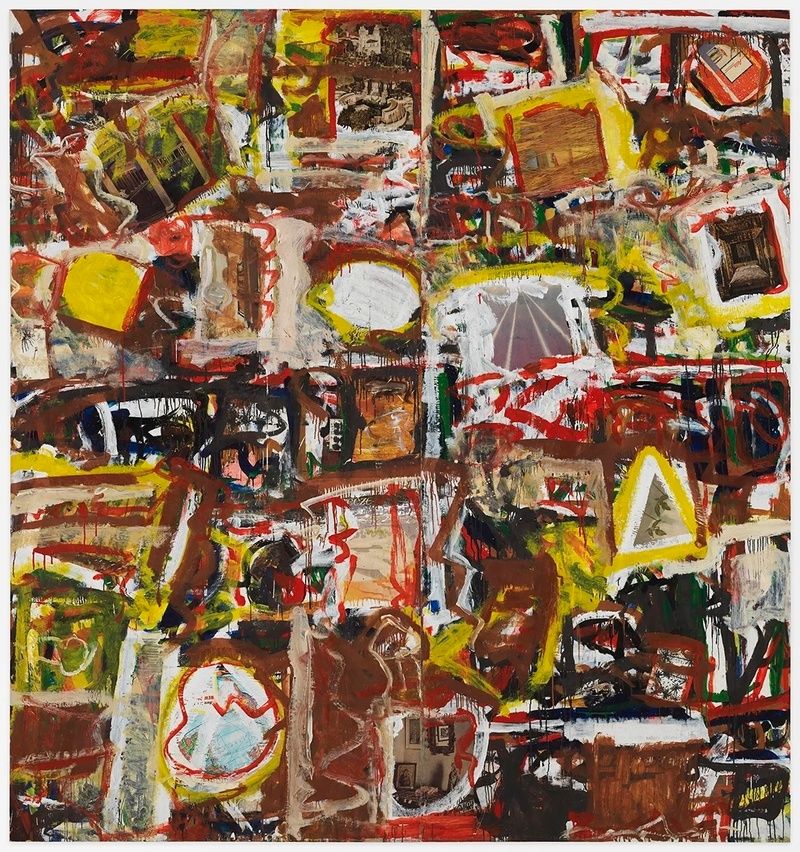
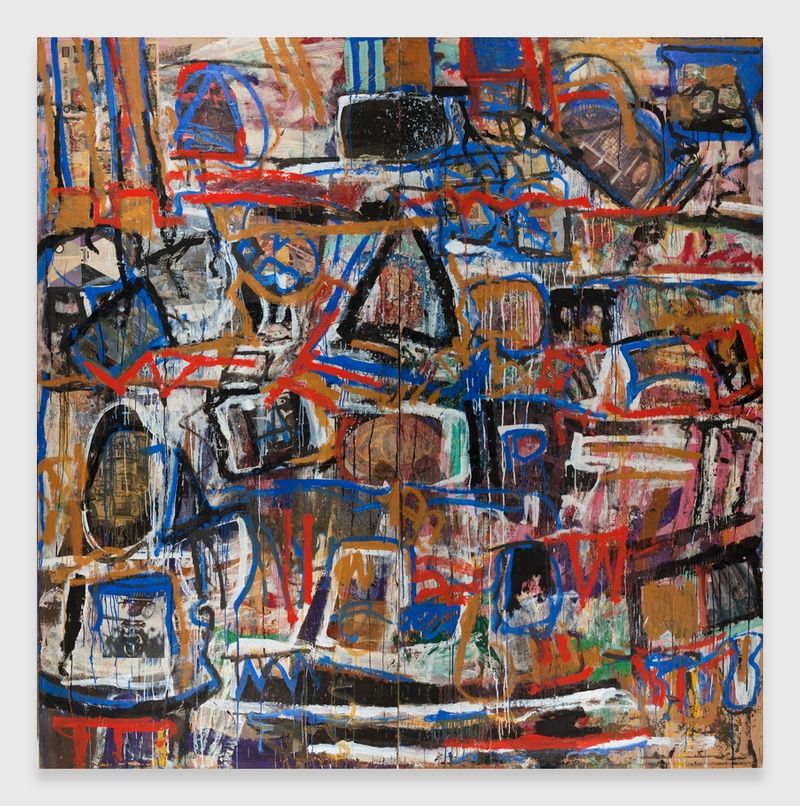
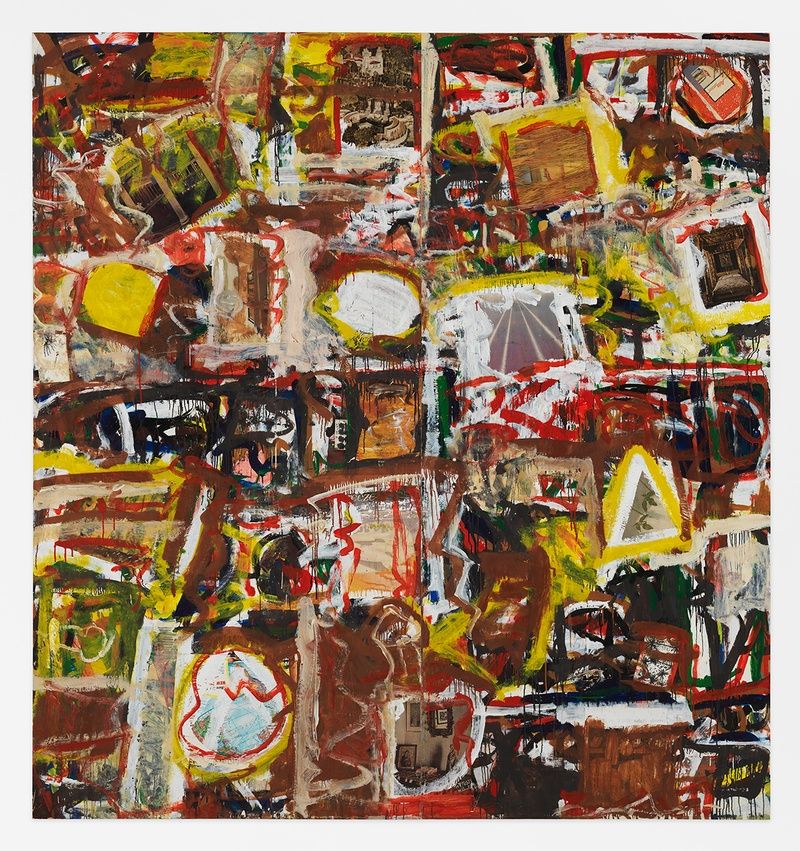
Among the largest in the series, two Collage works on view (both Untitled, 1959) embody the project’s formal and conceptual crescendo. In one, Held’s calligraphic painting plays against pasted illustrations from a 1957 LIFE magazine feature on Hearst Castle, William Randolph Hearst’s 115-room hilltop monument to American excess and media spectacle in the California hills. Accented by passages of yellow, red, and white, Held applies the paint in a more open manner, loosening the compressed structure of the Pigment Paintings. Via these layered fields, Held uses collage to register the world at hand even as his brushwork begins to strip that imagery down, treating both as raw material for a new, self-determined system of form. The second work displays a wider range of painterly structures and collage elements, including newspaper comics, ornate interior photography, and high-end consumer advertisements. Held’s circles, triangles, squares, and parallel lines become increasingly pronounced—framing and effacing the content of the mass media images while at the same time sketching a working method that he would soon refine in the hard-edge geometries of his Alphabet series.
Made between 1961 and 1967, the Alphabet Paintings radically eliminated expressionist brushwork in the search for increasingly potent elemental forms. In each, Held stages a monumental letterform—or an apparent fragment of one—so enlarged that it seems to fill past the picture’s edges. Held made this rapid leap by switching from oil to acrylic paint, which dried faster and resisted blending to deliver the harder, cleaner edges needed to strip gesture down to pure structure. Despite the series’ title, the Alphabet paintings evade pure letterforms, demonstrating the stark complexity that Held achieved in pushing the viewer to decipher such visually self-evident forms that only behave like letters. Broad zones of single color mediate through slight distortions and subtle formal decisions so that their blunt, hard-edged figures swell, tilt, and notch into the picture’s edges with a bodily sense of scale and compression.
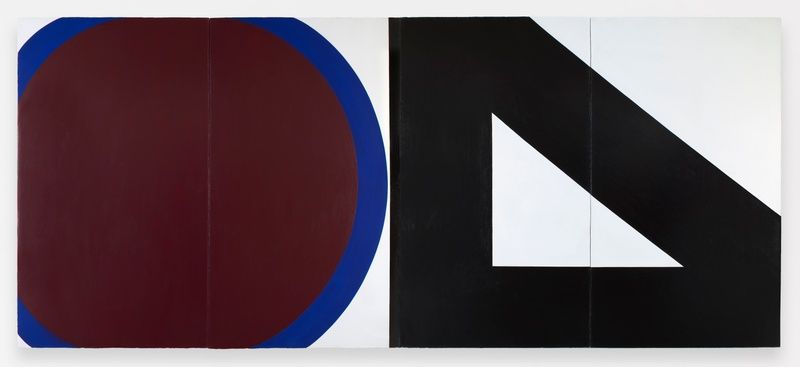
The Alphabet works crystallize the central concerns that define Held’s oeuvre: scale, structure, and the tension between illusion and surface. Reaching beyond Clement Greenberg’s flatness dogma, they read at once as oversized graphic signs and as heavier, wall-like objects whose presumed shadow alludes to a dimensional depth within the image. Featured in Held’s first institutional solo exhibition at the Stedelijk Museum, Amsterdam in 1966, Circle and Triangle (1964) reaches 12 feet high and spans 28 feet across four panels. The work’s two tightly cropped graphic figures give the illusion of standing behind giant billboard letters—perhaps a titanic ‘48,’ cut off and inverted—so that we might be looking out from behind the canvas rather than looking into it. The result is a language that never quite resolves, toggling between recognition and unexpected spatial dynamics as we try to literally read the image.
Seen in person, the Alphabet paintings contradict their own graphic bluntness. Beneath flat bands of color, Held’s repeated revisions of the image form an understructure of decision-making, still legible through buried layers of paint. The effect of toggling between figure and ground is pronounced in two considerably smaller works—The “N” (1963) and The Red X (1965)—chronologically bookending Held’s Circle and Triangle while showing how geometry and naming alike can stretch toward other modes of reading. Held tested how far letters and numbers can bend toward pure form and built a language that is always in the process of slipping from text into image and back again.
The deeply human, bodily charge of these paintings is inseparable from Held’s own unlikely path into art through a chain of political commitments, peer influence, and self‑education rather than any conventional schooling. Held grew up in working‑class neighborhoods in Brooklyn and the Bronx during the Depression. A habitual truant, he left school at sixteen and joined the Navy at seventeen, exiting after two unhappy years. Raised in a leftist household and steeped in progressive youth groups, Held reentered New York’s postwar leftist culture at nineteen. It was at this juncture that his interest in art was sparked by peers like Nick Krushenick, who first made the idea of being a socially engaged artist feel imaginable. Held invoked the GI Bill, attending the Art Students League among social realist and mural‑minded peers, while regular visits to MoMA shifted his focus from agitprop imagery to questions of structure, space, and abstraction.
When plans to study social realist painting with muralist David Alfaro Siqueiros in Mexico collapsed, Held instead moved to Paris, where he studied, exhibited, and absorbed postwar European abstraction before returning to New York in 1953. Over the following decade, he would gradually evolve from a gestural, pigment-heavy practice into the monumental hard-edge language that would culminate in the Alphabet paintings by the early 1960s. Held also shifted from oil paint to acrylic to achieve a harder, cleaner edge—slowly stripping gesture down to structure, then enlarging and clarifying that structure until it became a single sign.
The indelible achievements of Held’s endeavor were soon reflected in landmark exhibitions and scholarship, including Irving Sandler’s Concrete Expressionism at NYU (1965), Clement Greenberg’s Post Painterly Abstraction at LACMA (1964), and Geometric Abstraction in America at the Whitney Museum (1962), as well as in numerous solo museum exhibitions and his nearly two decades of teaching at Yale. Beyond the years represented in Epic Abstraction, Held sustained a long and influential career, continually expanding his investigations of perspective, space, and geometric language well after the 1960s until his passing in 2005.
James Fuentes would like to thank the Al Held Foundation and White Cube for their collaboration on this exhibition.
Al Held was born in Brooklyn, New York in 1928 and died in Todi, Italy in 2005. He exhibited extensively throughout his career including solo exhibitions at Stedelijk Museum, Amsterdam (1966); San Francisco Museum of Modern Art; and Corcoran Gallery of Art, Washington, DC (1968); ICA, Philadelphia (1968); Contemporary Arts Museum, Houston (1969); Whitney Museum of American Art, New York (1974); and ICA Boston (1978), among other museums. He produced major public artworks in prominent cities around the US. including Philadelphia, Washington, DC, New York, and Orlando. Held’s work features in many museums and public collections including those of The Metropolitan Museum of Art, New York; The Museum of Modern Art, New York; National Gallery of Art, Washington, DC; Neunationalgalerie, Berlin; and Kunstmuseum, Basel, Switzerland. He taught in the graduate program of the Yale School of Art from 1963–80.