James Fuentes Gallery
Alison Knowles
Secrets of Ordinary Things
Curated by Katrin Lewinsky
“The events I perform, the prints I have made and the environments I build are designed to put the spectator/performer in touch with him/herself and the real world. Since all feelings reside in the individual sensibility, I am interested in touching, awakening and activating certain of my own and your personal responses. Some of this happens through sound, some through the use of found objects in a given environment, some through the glorification of daily occurrences such as eating a sandwich or examining a button. I regard simple routine activities taken for granted, materials cast off as worthless, and unglorified products as worthy of all kinds of perusal. My environments and performances are collections of such things. Listen as if you had never heard it; look at it as if you had never seen it before. Investigate again what you already know.” – Alison Knowles
Curated by Katrin Lewinsky
“The events I perform, the prints I have made and the environments I build are designed to put the spectator/performer in touch with him/herself and the real world. Since all feelings reside in the individual sensibility, I am interested in touching, awakening and activating certain of my own and your personal responses. Some of this happens through sound, some through the use of found objects in a given environment, some through the glorification of daily occurrences such as eating a sandwich or examining a button. I regard simple routine activities taken for granted, materials cast off as worthless, and unglorified products as worthy of all kinds of perusal. My environments and performances are collections of such things. Listen as if you had never heard it; look at it as if you had never seen it before. Investigate again what you already know.” – Alison Knowles
Utilizing everyday materials, chance operations, and indeterminacy, Alison Knowles’s interactive performances, visual works, and installations engage sound, objects, and lived experience. Over the course of her six-decade career, Knowles invited viewers to become active participants, awakening personal perception through acts of listening, touching, and looking anew. Curated by Katrin Lewinsky in collaboration with the artist’s estate, Secrets of Ordinary Things marks the first presentation of Knowles’s work following the artist’s passing in 2025.
Spanning two floors, the exhibition foregrounds three elements residing at the core of Knowles’s multidisciplinary oeuvre: live performance, mixed media environments, and experiments with photo-sensitive materials. Celebration Red, Homage to Each Red Thing (1962/1996) occupies KinoSaito’s entrance level. The work originated in 1962 as an Event Score, an intentionally open-ended compositional form innovated by Knowles as a founder of the Fluxus group at the beginning of the 1960s. Structured by a simple grid and activated through the placement of red objects into the grid by visitors, Celebration Red unfolds as a living composition, continually transformed through attention, chance, and communal action. Rather than producing a fixed image, each gesture of exchange subtly alters the field, emphasizing community and the poetic potential of ordinary things. The work is among the earliest examples of an Event Score:
Any floor is divided into squares of any size. Into each square put one red thing:
a piece of fruit
a doll with a red hat
a shoe
for example. Completely cover the floor this way.
Since its origination, iterations of Celebration Red have appeared across the world, from New York to Indonesia, France, Germany, and the Netherlands. It was most recently featured in 2022 as part of the artist’s retrospective at the Berkeley Art Museum, which currently tours throughout Europe and will travel to the Grey Art Museum at NYU in New York City in late 2026. In each iteration, hundreds of visitors of all ages have joined in co-creating a unique version of the piece in their local environment.
Continuing upstairs in KinoSaito’s theatre space, a series of cyanotypes created between 1990 and 2002 represent a sustained body of works using light-sensitive chemical processes on paper and cloth. Created by placing or suspending everyday objects in front of these surfaces, both presence and absence are recorded through exposure to sunlight. Rather than treating photography as a fixed or purely optical medium, Knowles approached the cyanotype as an extension of performance. The making of these works was an event shaped by environment, duration, and bodily action as active collaborators in the image-making process. Installed together in the theatre space, the cyanotypes simultaneously trace action and stillness, functioning as quiet records of looking, waiting, and doing held in light and surface.
Throughout March, a curated program of Knowles’s Event Scores will be performed live in the theatre gallery, surrounded by the cyanotypes. In total, Knowles produced well over one hundred Event Scores. An early collection appeared in By Alison Knowles (1965) published by Something Else Press, which she co-founded with Dick Higgins in 1963 with the desire to make avant-garde and performance-based art accessible to a broad public. The live program will include a reading of The House of Dust (1967) score (often described as the first computerized poem), as well as live performances of several event scores spanning 1961-1963. The works will be performed by Hannah B. Higgins (Knowles’s daughter) and Clara Joy (Knowles’s granddaughter). Throughout these works, Secrets of Ordinary Things pays homage to Knowles’s indelible legacy across time and space. Reframing everyday objects, moments, and domestic life as sites of cultural and political meaning, her celebrated individual practice was distinct for its inseparability from collective participation and the dynamics of shared experience.
Alison Knowles (1933-2025) is defining force in postwar experimental art. Her six-decade career has indelibly transformed the boundaries of art and life as we understand them. Knowles was a founding member of the Fluxus group, whose ethos sought to disassemble traditional barriers between art forms, while rejecting the exclusivity of the art world in favor of art as an open and participatory experience accessible to all. Her expansive career is marked by major solo exhibitions including Alison Knowles at the Carnegie Museum of Art (2016) and By Alison Knowles: A Retrospective (1960–2022), originating at the Berkeley Art Museum & Pacific Film Archive (2022-23) and traveling to the Museum Wiesbaden, Germany (2024-25); MAMC+ Saint-Étienne Métropole, France (on view through March 15, 2026); Nikolaj Kunsthal, Copenhagen (April 25–July 26, 2026); and the Grey Art Museum at New York University (September 9–December 9, 2026). The House of Dust (1967) will be on view in New Humans: Memories of the Future, inaugurating the New Museum’s newly expanded galleries in New York opening March 21, 2026. Her work is in the permanent collections of the Tate Modern, London; Centre Pompidou, Paris; Museum of Modern Art, New York; Metropolitan Museum of Art, New York; Whitney Museum of American Art, New York; Smithsonian American Art Museum, Washington DC; Los Angeles County Museum of Art (LACMA); San Francisco Museum of Modern Art; Museum of Contemporary Art, Chicago; Art Institute of Chicago; Brooklyn Museum; Getty Research Institute, Los Angeles; Carnegie Museum of Art, Pittsburgh; Walker Art Center, Minneapolis; Philadelphia Museum of Art; Fondazione Bonotto, Italy; Stedelijk Museum, Amsterdam; Hamburger Bahnhof, Berlin; Staatsgalerie Stuttgart, Germany; among many others. Her profound contributions to artistic practice were recognized through awards including an Anonymous was a Woman Grant (2003) and College Art Association Lifetime Achievement Award (2003), as well as a Harvard Radcliffe Fellowship (2009-10), Dokumenta Professorship at the Kunstakademie Kassel, Germany (1998), New York State Council on the Arts Grant (1989), NEA Grants (1981, 1985), and a Guggenheim Fellowship (1968). She received honorary doctorates from the Pratt Institute (2015), Columbia College Chicago (2009), and Maine College of Art (2002). Knowles’s work has been detailed in major publications including By Alison Knowles: A Retrospective (1960-2022) (University of California, 2022). Her central role within the Fluxus movement is explored in Fluxus Experience by Hannah Higgins (University of California Press, 2002). Performing Chance: The Art of Alison Knowles In/Out of Fluxus by Nicole L. Woods was released this year by the University of Chicago Press.
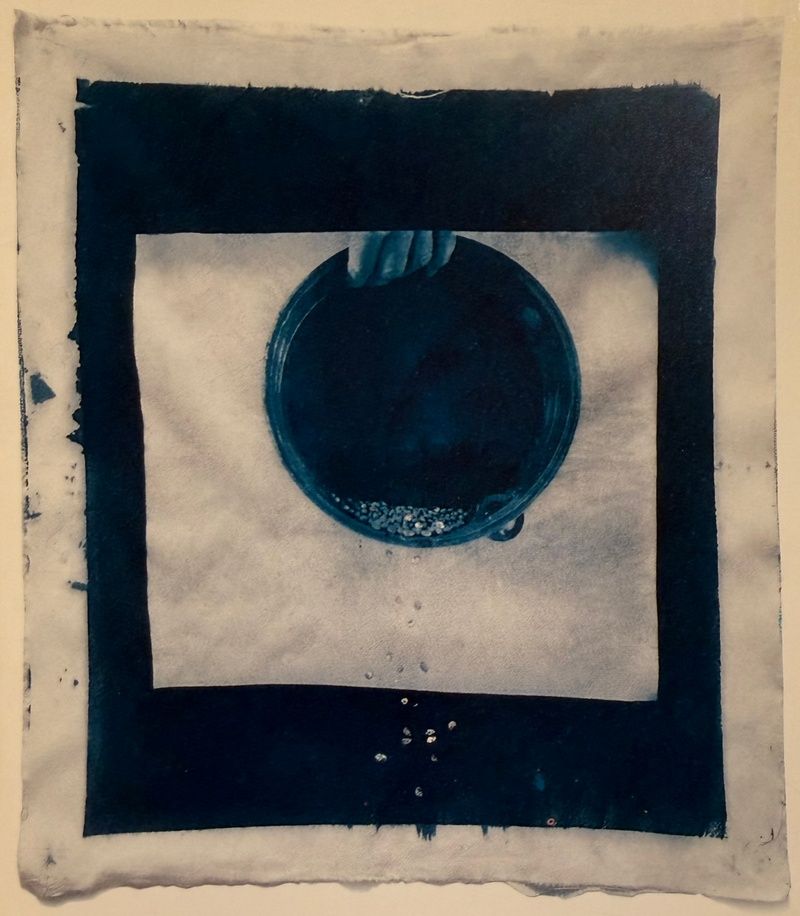
Alison Knowles
Tambourine with Beans Falling, 2002
Photo image and cyanotype on cloth
20 ½ × 23 ½ inches