James Fuentes Gallery is pleased to present Becky Howland, Paintings: 1995-2025 in New York. Active since the late 1970s, Howland is widely recognized for her works expressing a deep ecological concern in the presence of energy extraction and distribution, political power, and the environmental consequence of contemporary life. Celebrated for the highly direct and inventive nature of her art making, Howland is also a key figure in experimental artist collectives still active today in New York City, notably as a member of Colab (Collaborative Projects Inc, formed 1977) and for her principal role in the landmark “Real Estate Show,” which established ABC No Rio in 1980. Against the backdrop of such activities as well as her better-known large-scale sculptural works, this exhibition presents a focused survey of her paintings, many of which have never previously been exhibited.
Raised outside of Buffalo, New York, Howland grew up amid landscapes punctuated by the presence of power plants, oil storage tanks, and steel refineries. These early encounters with the imposing structures of transmission towers and burning oil refinery stacks continue to shape her attentiveness to the energy of plants, animals, and humanity in built environments. This awareness formed in tandem with an emerging political consciousness—the artist’s teenage and college years were marked by political assassinations, Vietnam war protests, and the Watergate scandal—as well as a certain generational idealism as marked by the first Earth Day in 1970. During this time, Howland also spent a year in Japan studying the country’s temple gardens, ceramics, and the Japanese language. Her paintings, in particular, reflect a confluence of historical and cross-cultural sources—Indian and Persian miniature paintings, Chinese poems, Japanese sculpture, and European Cubism—into compositions that are both formally inventive and conceptually layered.
James Fuentes Gallery is pleased to present Becky Howland, Paintings: 1995-2025 in New York. Active since the late 1970s, Howland is widely recognized for her works expressing a deep ecological concern in the presence of energy extraction and distribution, political power, and the environmental consequence of contemporary life. Celebrated for the highly direct and inventive nature of her art making, Howland is also a key figure in experimental artist collectives still active today in New York City, notably as a member of Colab (Collaborative Projects Inc, formed 1977) and for her principal role in the landmark “Real Estate Show,” which established ABC No Rio in 1980. Against the backdrop of such activities as well as her better-known large-scale sculptural works, this exhibition presents a focused survey of her paintings, many of which have never previously been exhibited.
Raised outside of Buffalo, New York, Howland grew up amid landscapes punctuated by the presence of power plants, oil storage tanks, and steel refineries. These early encounters with the imposing structures of transmission towers and burning oil refinery stacks continue to shape her attentiveness to the energy of plants, animals, and humanity in built environments. This awareness formed in tandem with an emerging political consciousness—the artist’s teenage and college years were marked by political assassinations, Vietnam war protests, and the Watergate scandal—as well as a certain generational idealism as marked by the first Earth Day in 1970. During this time, Howland also spent a year in Japan studying the country’s temple gardens, ceramics, and the Japanese language. Her paintings, in particular, reflect a confluence of historical and cross-cultural sources—Indian and Persian miniature paintings, Chinese poems, Japanese sculpture, and European Cubism—into compositions that are both formally inventive and conceptually layered.
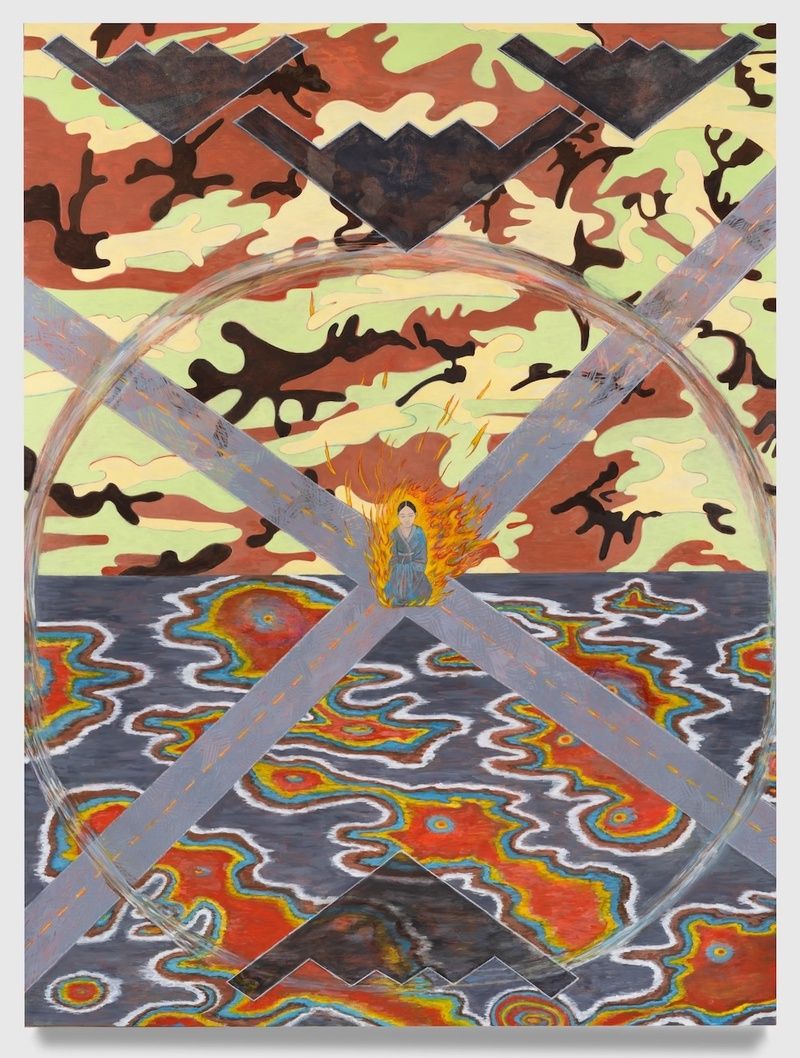
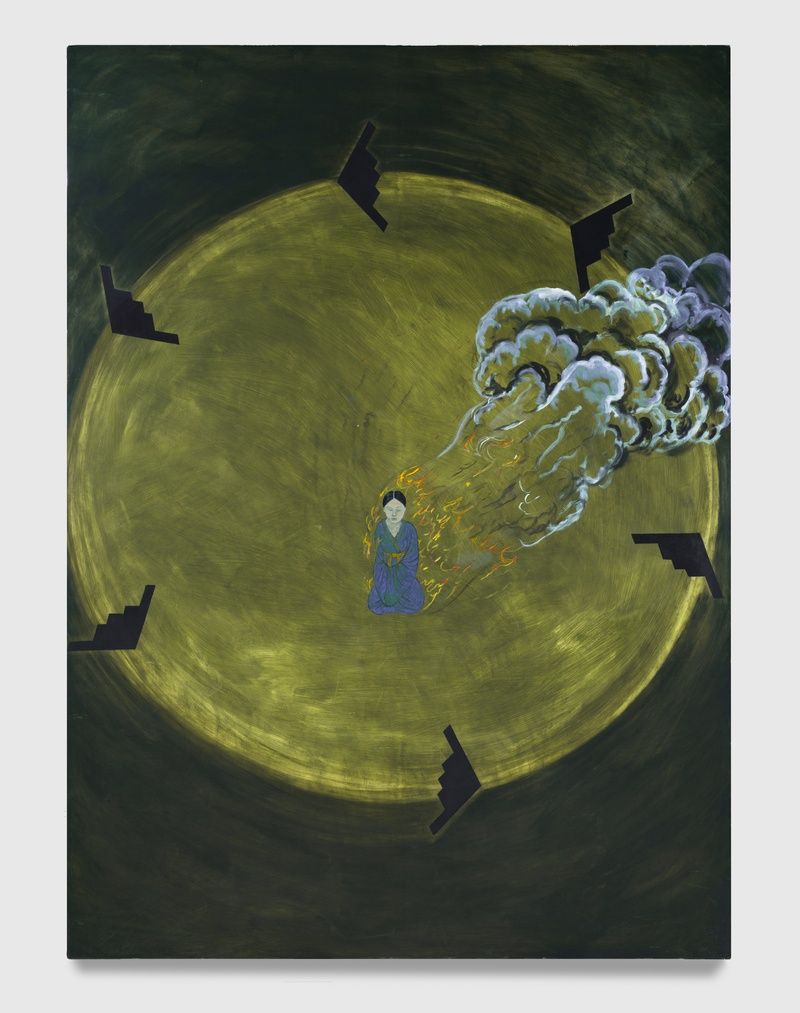
Works like Burning Girl and Stealth Bombers (2003-04) and Oil Spill and Camouflage (2007/2025) reflect a potent meeting of such subjects and influences. In the former, Howland juxtaposes an eighth-century Japanese sculpture engulfed in flames, referencing the Buddhist Monks who self-immolated in protest of war in Vietnam. Against a field of green, she is circled by the conspicuous triangular forms of B-2 Stealth Bombers. In the latter, the same burning woman appears in the crosshairs of two built roads and another set of Stealth Bombers. The background forms an abstracted horizon-line between a camouflage-print sky and an oil-slick ocean. In contrast, Ring of Fire, with Water Garden (2001-02) depicts an ancient burning being at the center of a green garden, surrounded by a gridded garden. A ring of fire separates the two as several birds circle overhead. Flowing from hatched eggs and a strand of DNA, these combinations suggest a distinctly biological cycle of life, death, and rebirth.
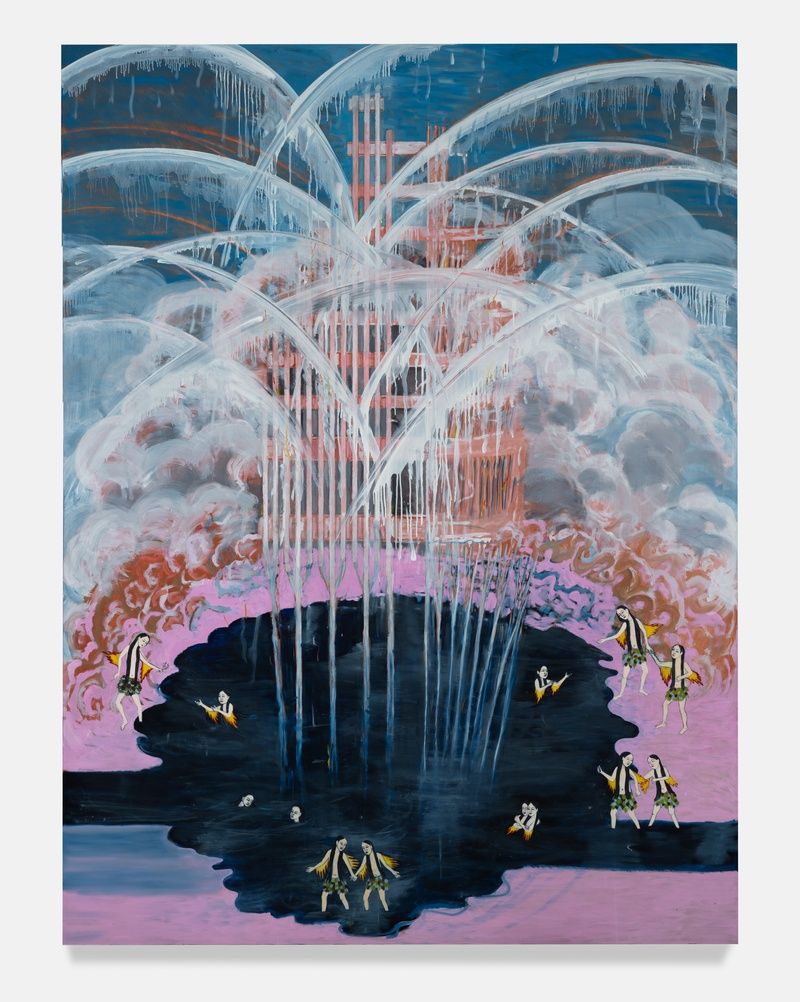
The brutal displacement of such cycles is addressed unequivocally in Four Month Fire (2002-04), which the artist made in the wake of 9/11. As a long-term resident of Lower Manhattan, Howland physically experienced the attack and its aftermath. As the fires at the World Trade Center burnt for months, she visited the site to draw what she saw. This painting witnesses the tower’s smoldering steel skeleton and the plumes from the water used to extinguish the fire. In a central pool of dark water, small angels with wings of fire (reproduced from a Persian miniature) console one another as the tower’s structure and streams of water transform into a monumental fountain. Howland reflects, “I make art to process the world.”
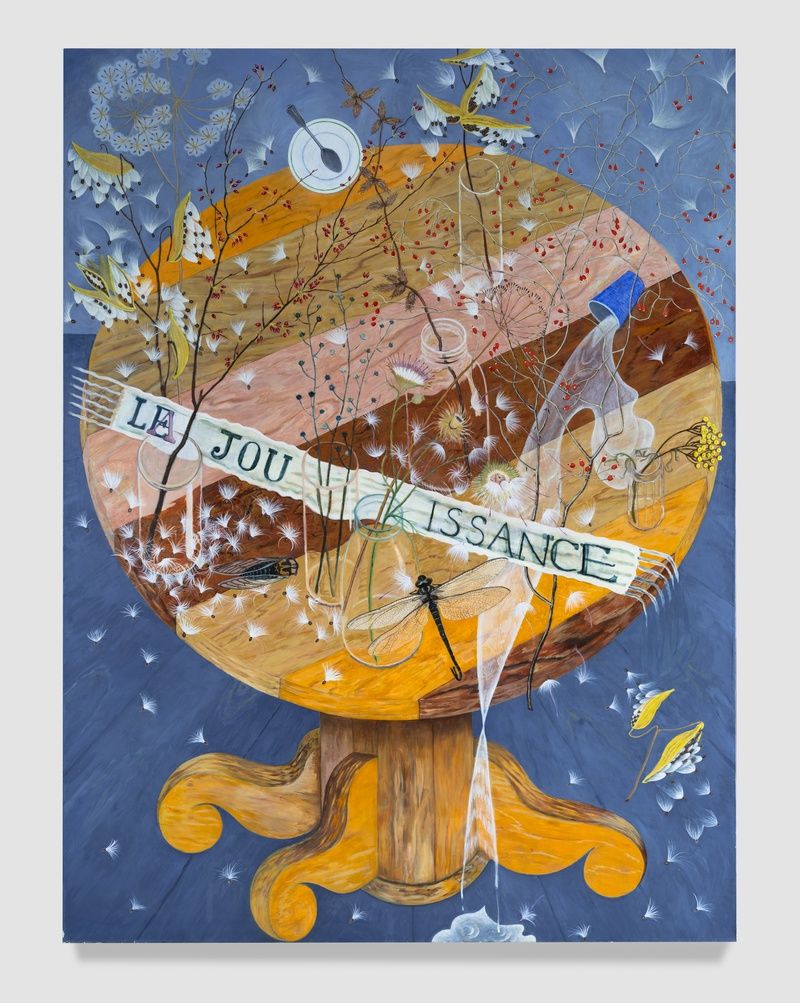
Completed during this same period, works like Good Energy (2002-03) and La Jouissance (1996-98; 2002-03) reflect a transmutation of such catastrophe through ritualized imagination. Reaching for what Howland describes as, “a different kind of energy,” these works suggest the lively and mysterious connection between human, animal, and plant. The latter, a still life from the artist’s studio, expresses an untranslatable phrase found in French feminist literature, La Jouissance—defined as the “enjoyment of rights: sexual, political, and economic. Total access, total participation, total ecstasy.” Both works intermingle flora and fauna, connecting to Howland’s Weeds of New York series made over the preceding decades. Across those vertical canvases, a medley of plants (named in the title of each) overtake an emptied background. To Howland, these weeds are survivors—uprooted and determined to thrive through the cracks of industrial life.
Becky Howland (b. Niagara Falls; lives and works in New York) graduated with a BFA in sculpture from Syracuse University in 1974 and an MFA in painting from Bard College in 1999. Her work has been exhibited at Swiss Institute, MoMA PS1, Socrates Sculpture Park, Printed Matter, ABC No Rio, Moiety Gallery, and Know More Games in New York, and Freddy in Baltimore. Among many artist-organized projects in the late 1970s and throughout the ‘80s in New York, Howland was a participant in the “Times Square Show” and “Real Estate Show.” A principal organizer of the latter, she was part of the negotiation that—following the artists’ takeover and subsequent police lockout of a disused city-owned building at 123 Delancey St—led to the founding of ABC No Rio. This project was reiterated with “The Real Estate Show Revisited” on Delancey St in 2014 at James Fuentes Gallery. Following a decade of advocacy, ABC No Rio will inaugurate its new building at 156 Rivington St later in 2026.
Oil Spill and Camouflage, 2007/2025
Oil on canvas
80 × 60 inches