Something is always lost in representation. To relay a story, regardless of language—verbal, visual, and otherwise— contending with a certain degree of loss is inevitable. To that end, looking, particularly active looking, might be akin to mourning. The artists in OffSight fill this space of loss with acts of inventive, alchemical storytelling. What is lost in their works is not always immediately evident; some conditions are best kept between an artist and their process. What is unmistakable, however, is how each succeeds at making me miss something I didn’t know I needed. It’s in this moment that sight becomes a ritualistic and sacred temporal act.
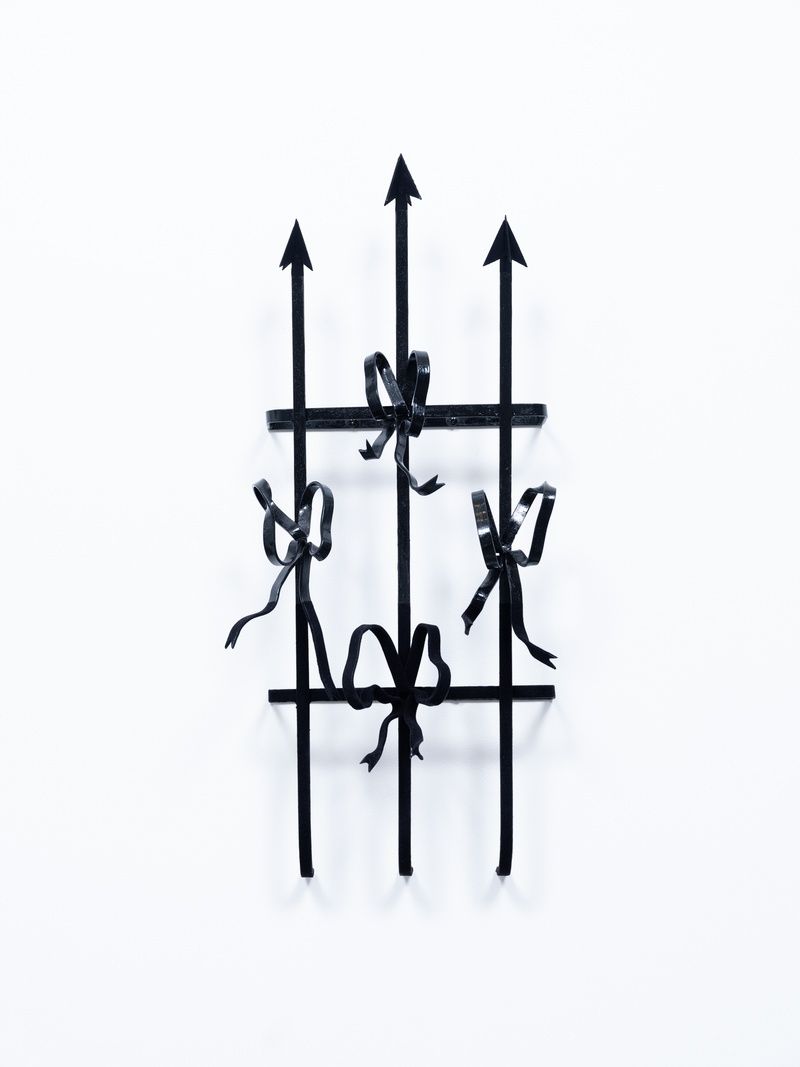
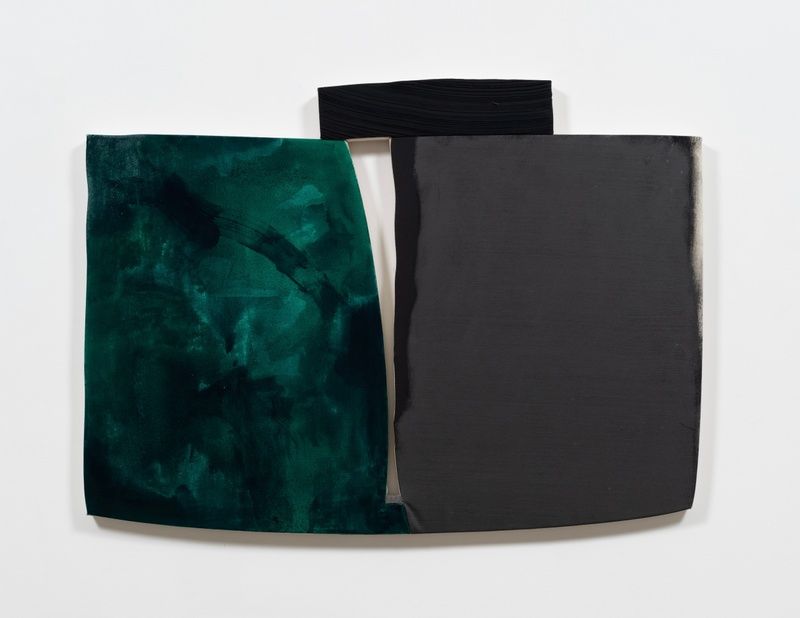
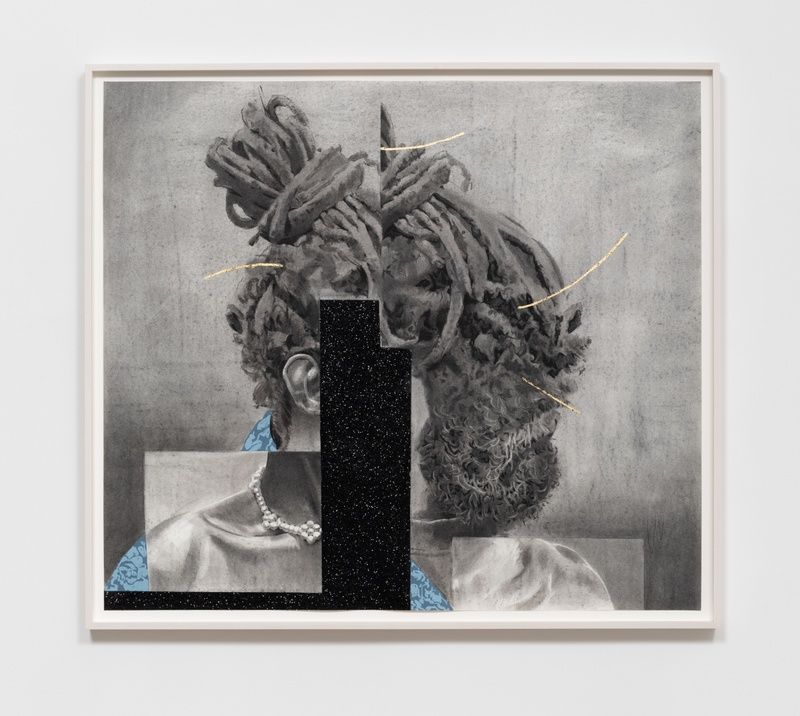
The longing I’m suggesting here is the good kind of longing. The redemptive kind. The kind of longing that helps us heal from the ruptures of stepping outside of our bodies. Instead of promising branded truths, these artists propose a quality of presence that rewards active looking and (re)discovery. They heighten our awareness of the air that fills the space between the limits of our sight and the surfaces of their subjects. In this air my breathing slows and deepens as I look more intently at their work: I look more closely at the citations of architecture, nomadic instruments, and suggestions of ruin in the sci-fi sculptures of Abigail Lucien. In Cosmo Whyte’s drawing I face a dense and weighted apparition. Ornamented, adorned, and at the same time obscured, the figure (or is it two?) seems to shape-shift before our eyes. In Widline Cadet’s intimate pictures, bodies become enmeshed with each other and with the landscape, as in this work, in which they disappear altogether. In doing so, Cadet’s characters expand themselves beyond the limitations of any singular subjectivity. Likewise, as objects, Leslie Smith III’s modular paintings fragment and compartmentalize the sometimes planar expectations of painting, yielding slices of color, shape, and form in ways that disobey the bounds of the picture.
As Paul Anthony Smith plucks into the surfaces of his pictures, he conceals an additive gesture inside of a reductive process—not only cloaking or armoring figures but transforming them into something possibly truer and more present than humans are allowed to be. Reconstructing a classical sense of composition, Destiny Belgrave’s portrait lovingly regards ancestry as it lives in familial acts of care and nourishment. Mark Fleuridor‘s portrait of a loved one parallels this process, collapsing personal memory and family narratives inside a visually layered, kaleidoscopic image. In their own ways, both Belgrave and Fleuridor use collage as a means of distinguishing family histories that are more often hidden, camouflaged, or withheld. Through this form they find potential paths of release and recombination in order to tell stories in and of the aftermath of generational movement and immigration.
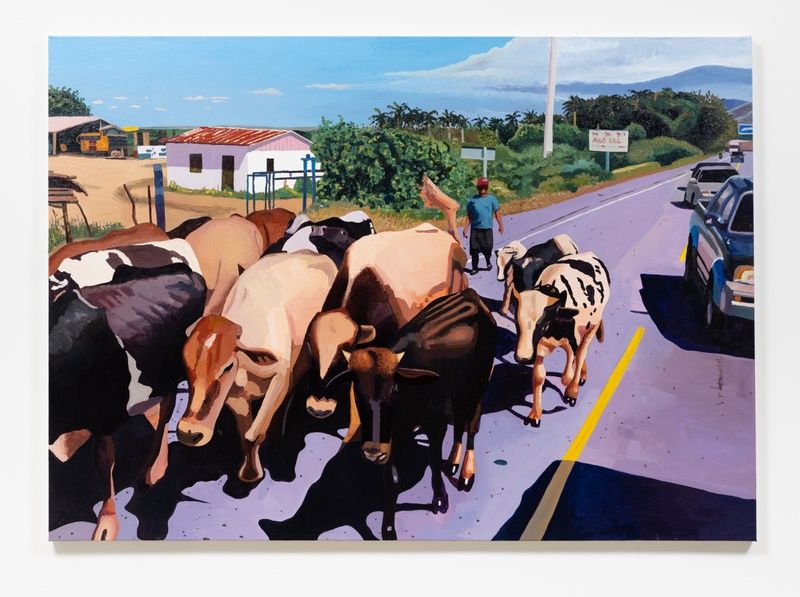
Marianna Olague’s narrative portrait places attention on tenderness in community, set against the presence of physical boundaries that may serve as either border or protection. Raelis Vasquez’s naturalistic paintings call forth questions of class, race, and geography. In both, their use of intense color antagonizes my attempts to make rigid their otherwise pulsing scenes. They burn like hot lights into the retina, imprinting family stories that have passed through generations— becoming more affective than they are “true.” Alex Jackson’s painting turns this gazing into electricity that traces the paths of looking across the entirety of his surface. The aftershocks of this encounter—a seemingly infinite expanse made of overlapping and intersecting marks—bridges new stories and forms, and at other times intentionally foil our desires to make sense of their exuberant performances.bAll of these artworks point me toward what I miss when I’m looking. They ask us to consider where the limits of an object or image fall short, and find space in the simply unknowable. With them I redirect my gaze to the corners, the gaps, and the pockets of our narratives that reveal more to us about ourselves than we already know.
—Didier William
ARTISTS:
Abigail Lucien (b. 1992) was raised in Cap-Haitian, Haiti and Florida. Their sculpture, poetry, video, and sound work has been exhibited at SculptureCenter (NY), MoMA PS1 (NY), MAC Panamá, Atlanta Contemporary (GA), UICA (Grand Rapids, MI), and The Fabric Workshop and Museum (Philadelphia, PA). Residencies include the Eugeniusz Geppert Academy of Fine Arts (Wrocław, Poland), The Luminary (St. Louis, MO), Santa Fe Art Institute (NM), and Ox-Bow School of Art & Artists’ Residency (Saugatuck, MI); and in the spring of 2023 they will take part in the Amant Studio & Research Residency (NY). Lucien was named to the 2021 Forbes 30 Under 30 list, is a recipient of a 2021 VMFA Fellowship, and the 2019 Harpo Emerging Artist Fellow. Lucien lives and works in Baltimore, MD, where they teach Interdisciplinary Sculpture at the Maryland Institute College of Art.
Leslie Smith III (b. 1985) was born in Silver Springs (MD) and lives and works in Madison (WI). He received an MFA from the Yale School of Art and BFA from the Maryland Institute College of Art. His work has been exhibited at the Madison Museum of Contemporary Art (WI), Museum of Contemporary Art Denver (CO), Abroms-Engel Institute for the Visual Arts Museum, Birmingham (AL), Skirball Museum, Cincinnati (OH), Contemporary Art Museum Houston (TX), Milwaukee Museum of Art (WI). His work can be found in the permanent collections of the High Museum of Art (Atlanta, GA), the Virginia Museum of Fine Art (Richmond, VI), the Birmingham Museum of Art (AL), the Abroms-Engel Institute for the Visual Arts, Birmingham (AL), and the FRAC Auvergne, France. In 2009 he received a Fellowship from the American Academy in Rome. Smith is currently an Associate Professor of Painting and Drawing at the University of Wisconsin-Madison.
Alex Jackson (b. 1993) was born in Milwaukee (WI) and lives and works in Philadelphia (PA). He received an MFA from Yale University in 2017 and BFA from the University of Wisconsin-Madison. He has attended residencies at Yale Norfolk, Skowhegan School of Painting and Sculpture, and The Royal Drawing School at Dumfries. He has exhibited at Jenkins Johnson Projects, Brooklyn (NY), Parts and Labor, Beacon (NY), Bronx Art Space, Bronx (NY), Elmhurst Art Museum, Elmhurst (IL), Mills Gallery at Boston Center for the Arts, Boston (MA), Zevitas Marcus, Los Angeles (CA), 1969 Gallery, New York (NY). His work is represented in the collections of the The DeYoung Museum, The Santa Barbara Museum of Art, and The Studio Museum in Harlem.
Marianna Olague (b. 1990) holds an MFA in painting from Cranbrook Academy of Art in Bloomfield Hills, Michigan, and BFA Her from the University of Texas at El Paso in El Paso, TX. Her work has been exhibited at Smithsonian National Portrait Gallery (Washington, DC), Cranbrook Art Museum (Bloomfield Hills, MI), and Rubin Center for the Visual Arts (El Paso, TX), and David Klein Gallery (Detroit, MI). Olague was awarded a Chinati Foundation Residency in 2021. Her work is represented in various private and public collections, including the Rubin Center for the Visual Arts in El Paso and Cranbrook Art Museum. Olague is represented by David Klein Gallery. She lives and works in El Paso, Texas.
Paul Anthony Smith (b. 1988) is a Jamaica-born artist living and working in Brooklyn, New York. He received a BFA from the Kansas City Art Institute, Kansas City (MO). Solo exhibitions include the Atlanta Contemporary (GA), Kemper Museum of Art, Kansas City (MO) traveling to the Blaffer Art Museum, Houston (TX), Jack Shainman Gallery, New York (NY), Luis De Jesus, Los Angeles (CA), The Green Gallery, Milwaukee (WI); with group exhibitions including at the Smithsonian Institution, Washington D.C.; Somerset House, London; The Studio Museum in Harlem (NY), Brooklyn Museum (NY), Nasher Museum of Art, Durham (NC), and, Seattle Art Museum (WA). Smith’s works is found in the public collections of the Minneapolis Institute of Art (MN), Blanton Museum of Art, University of Texas at Austin (TX), and Minnesota Museum of Art, St. Paul (MN), and The Dean Collection, New York (NY), among others. He has undertaken residencies at the MacDowell Colony (NH), Anderson Ranch Arts Center (CO), and received a grant from the Art Omi International Residency.
Widline Cadet (b. 1992) was born in Pétion-Ville, Ayiti and lives and works in New York (NY). She received an MFA from Syracuse University (NY) and a BFA from the City College of New York (NY). She received a 2013 Mortimer- Hays Brandeis Traveling Fellowship, was a 2018 Skowhegan School resident, a 2019 Lighthouse Works fellow, a 2019 Syracuse University VPA Turner artist in resident, a 2020-21 artist in residence at The Studio Museum in Harlem, and a 2021-2022 visual arts fellow at The Fine Arts Work Center. Her work has been featured in Aperture Magazine, FOAM, The New Yorker, TIME Magazine, The New York Times Magazine, Financial Times, Wallpaper* among others. Cadet has exhibited in the U.S. and internationally and her work is held in collections including The Museum of Contemporary Photography, The Huis Marseille, The Los Angeles County Museum of Art (LACMA), The Pérez Art Museum Miami (PAMM), The Milwaukee Art Museum, and The Princeton University Art Museum.
Mark Fleuridor (b. 1996) is a Miami-based Haitian- American artist. He received a BFA from the Maryland Institute College of Art and has exhibited at Sperone Westwater, New York (NY), Art and Cultural Center, Fort Lauderdale (FL), Regular Normal, New York (NY), Bass Museum, Miami (FL), Wassaic Project, Wassaic (NY), and Brooklyn Academy of Music, Brooklyn (NY). He has been an artist in residency at Art Omi in Ghent (NY); Anderson Ranch Arts Center in Aspen (CO); Vermont Studio Center in Johnson (VT); and Oxbow Artist Residency in Saugatuck (MI). He has been a visiting lecturer at institutions including Perez Art Museum Miami (FL), Florida International University (FL), and Auburn University (AL).
Destiny Belgrave (b. 1996) was born and raised in Brooklyn, New York and nurtured with a Bajan and African American upbringing. She graduated a BFA from the Maryland Institute College of Art in 2018. She has exhibited at Sperone Westwater, New York (NY), A.I.R. Gallery, Brooklyn (NY), Brooklyn Public Library (NY), Olympia, New York (NY), and Monique Meloche Gallery; Chicago (IL). Belgrave is currently a 2021-2022 Studio Artist at Smack Mellon Studio Residency in Brooklyn, and was the 2020-2021 Fellow at A.I.R. Gallery, Brooklyn.
Raelis Vasquez (b. 1995) was born in Mao Valverde, Dominican Republic and lives and works between New York and New Jersey. Vasquez receive an MFA from University (NY) and BFA from The School of the Art Institute of Chicago (IL). Their work has been exhibited at El Museo del Barrio, New York (NY), Jeffrey Deitch, Los Angeles (CA), Jenkins Johnson, Brooklyn (NY), UTA Artist Space, Beverly Hills (CA), Steve Turner, Los Angeles (CA), and San Francisco Art Institute (CA).
Cosmo Whyte (b. 1982) was born in St. Andrew, Jamaica and lives and works in Los Angeles. received an MFA from the University of Michigan (MI) and BFA from Bennington College (VT). Whyte has exhibited at MCA Chicago (IL), Contemporary Art Center, New Orleans (LA), MOCA, Atlanta (GA), The High Museum, Atlanta (GA), The Drawing Center, New York (NY), Jack Shainman Gallery, New York (NY), Anat Ebgi, Los Angeles (CA), Goodman Gallery, Johannesburg, South Africa; National Gallery of Jamaica, Kingston, Jamaica; and Barbados Historical Museum, Bridgetown, Barbados; and has been the recipient of fellowships from the Vermont Studio Residency Full Fellowship (VT) and The Drawing Center (NY). Whyte is presently Assistant Professor at the College of Art and Architecture, UCLA, Los Angeles (CA).