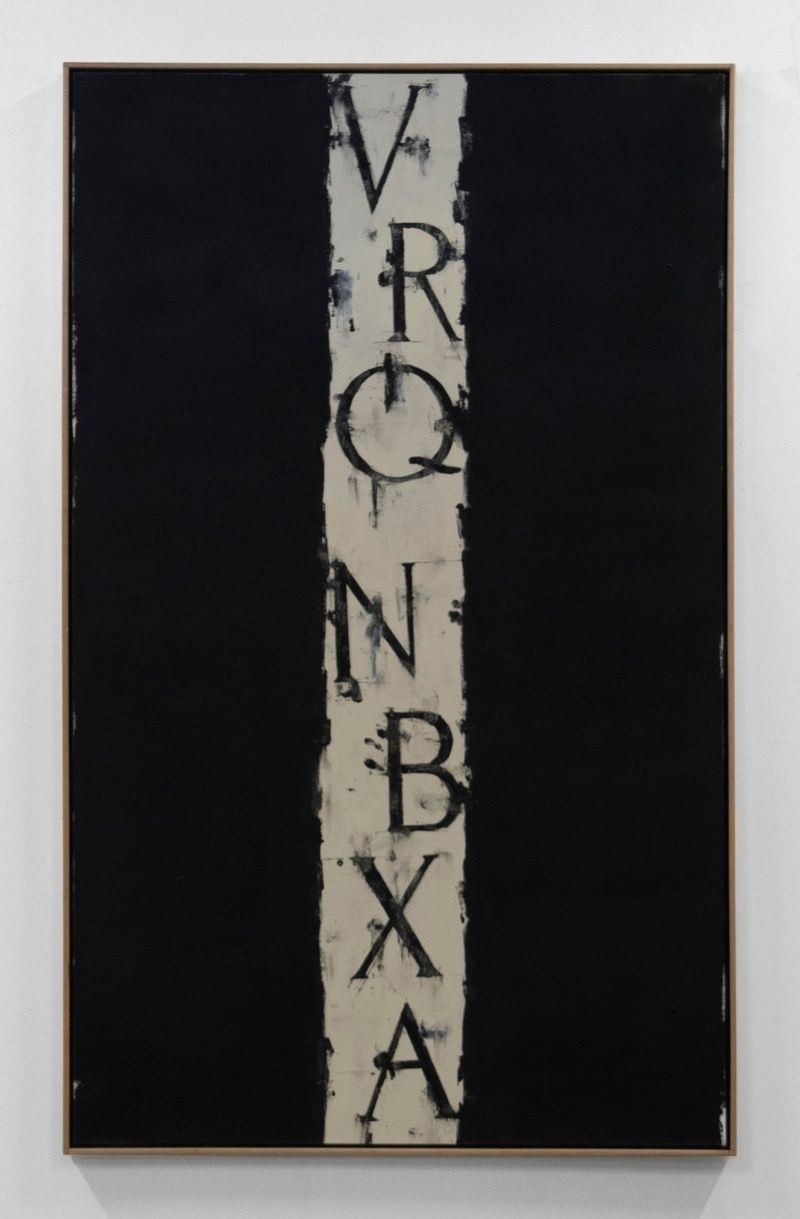
James Fuentes Gallery is thrilled to present Kikuo Saito: Alphabet Paintings. Born in Tokyo, Kikuo Saito (1939–2016) moved to New York in 1966 and developed a singular body of abstract work in both visual art and theater. This exhibition offers a comprehensive introduction to the Alphabet Paintings, a major series produced by Saito from the 1990s to the 2010s, standing at the center of his investigation of color, form, and vision.
Before leaving Tokyo, Saito spent three years in the studio of traditional painter Kiyonaga Ito, while admiring the experiments of the Gutai group. In New York he worked as a studio assistant to central figures in Color Field painting, the vital postwar American movement that poured and spread saturated expanses of pigment across canvases. From the theater, he brought commitments to improvisation and chance operations, joining them to Color Field’s metamorphic ambitions for color. Made by an artist who arrived in New York surrounded by novel signs and symbols, the Alphabet Paintings treat their subject not as messages to read but as a powerful new world to live with and transform.
Works in the series each offer a gridded canvas, stenciled with letters from the Latin (or Roman) alphabet, and made with vibrating color and gestural brushwork. For paintings in the group, Saito began by painting a base color and creating a grid of 10 inch squares across the canvas. After sharing lunch at a favorite Chinatown diner, Saito's assistant would lay down hand-made cardboard stencils of letters from a box in the studio and trace them in graphite onto the blank squares of the canvas. The artist would then paint the letters and begin to develop the overall composition. The work became an orderly grid of random letters, resembling a scrambled crossword puzzle or street sign, as in Blue Chair I (1996): “A L R F U O // D E Q _ Z S.” They deliberately eschew linguistic meaning despite relying on the building blocks of written language.
The artist’s first inspiration for the Alphabet Paintings came via the stage. He served as a writer, director, and set designer in New York’s downtown scene (his work in the theater began decades before that, as a lighting designer in Tokyo’s burlesque cabarets). Saito loved the minimal, formal restraint of Noh theater, and his own stage work shared its economy. His wordless play Toy Garden (1996), for example, relied on image rather than dialogue to create its haunting effect. Its painted theatrical backdrop repeated the words “VENICE” and “VENEZIA” across a large-scale grid, so that language became a symbolic setting, divorced from any claims to visual naturalism. His early Alphabet Paintings shared this strategy on canvas: in Venetian Window (1996), a grid of letters largely stripped of meaning gives way to fields of color that draw light across the surface.
Early entries in the series, such as Gray Duke (1996), tend toward spare compositions. These initial paintings are strikingly gridded works, with lightly brushed apertures of color opening through and across the canvas. As the project deepened across decades, the works increasingly emphasized all-over sweeps of gestural paint, as in Fisherman's Drum (2011), with its tangled mass of kinetic brushwork. While he worked on the series, his own perception physically changed. Saito developed cataracts which darkened his field of vision, a shift visually and thematically explored in late works such as Black Window-V (2011). In that painting, two black slabs, ragged and brushy, press on a light interior band as if the dark itself is creeping inward, eating at its margins. The color field artist charts out perceptual narrowing: an abstract sensation collapsing into darkness.
Saito frequently worked on a painting for weeks or more, driven in particular by the desire to find and invent the right balance of color. His practice was that of returning over and over to a canvas. As a former student recounted his teaching: “I need to work like a farmer.” If a composition proved especially difficult, he would put it aside for months – letting it “pickle,” as he said, on hold while his vision fermented. This search was never a mechanical formalism, but an exercise in imagination: how might an artist lead viewers towards new sensations and colors, novel ways of experiencing the world in and through art? His devotion to color made him one of the first customers of Golden Artist Colors, a leading manufacturer of acrylic paints in the US. He shared regular conversations with their staff, even asking that they produce a more intense blue–a pigment the company retitled "Saito Blue" after his passing. Color here, for Saito, stood for a symbolic restitution of the drained world, the quantified and merely gray, which might be glimpsed through art.
The Alphabet Paintings map out a relationship between pre-existing conditions, beyond the artist’s control, and an ability to construct meaning through them. Saito's method delegates the initial act, removing artistic authority–the grid is a given, already-made matrix that can be endlessly repeated. The following operation is similarly beyond the artist: the assistant selects random letters and copies them to canvas. Their meaning is deliberately emptied out, becoming signposts of language rather than overt messages. He even kept a sheet of paper at the studio, labelled in Japanese script: “my favorite letters of the alphabet,” marking them as objects of aesthetic appreciation. As a result, so many of the claims made for abstract painting–as a trace of feeling and record of interiority, the self poured onto canvas–are reversed in these works. Saito instead shows a subject built from the spaces and materials around us: what we do with the conditions we find ourselves in.
The Alphabet Paintings balance multifaceted responses to language: vulnerability, the thrill of a new tongue, and the sheer physical presence of words. Saito found much to love in New York, its alphabet included. For a migrant artist who arrived in a city of unfamiliar signs, the paintings propose a way of living: not by decoding every phrase and letter, but by taking the new world he encountered and reimagining it, block by block, square by square.
Text by David Sledge