James Fuentes is pleased to present Juanita McNeely: Holding Back in New York. Driven by the need to “make the ugly and the terrible beautiful for myself,” McNeely’s powerful visual vocabulary focuses on the human condition through radiant color ranges animated by light and shadow. Surrounding her highly recognizable figures—human and animal, often seemingly both at once—McNeely established a distinct set of visual devices that would crystallize her visceral imagery into deeply metaphysical confrontations with form. The exhibition spotlights a group of works begun in the 1980s and spanning her late career, steeped in vivid cobalt and deep ultramarine blues as an expressive and unifying force.
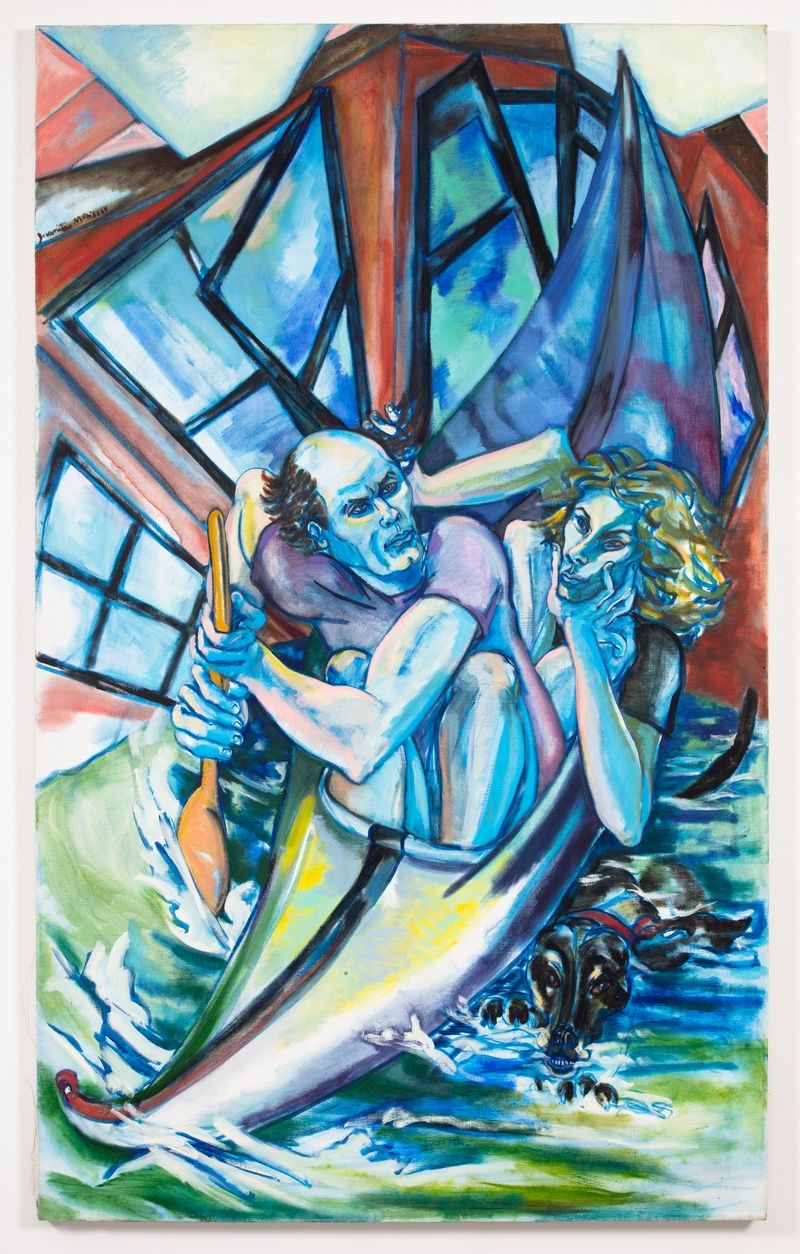
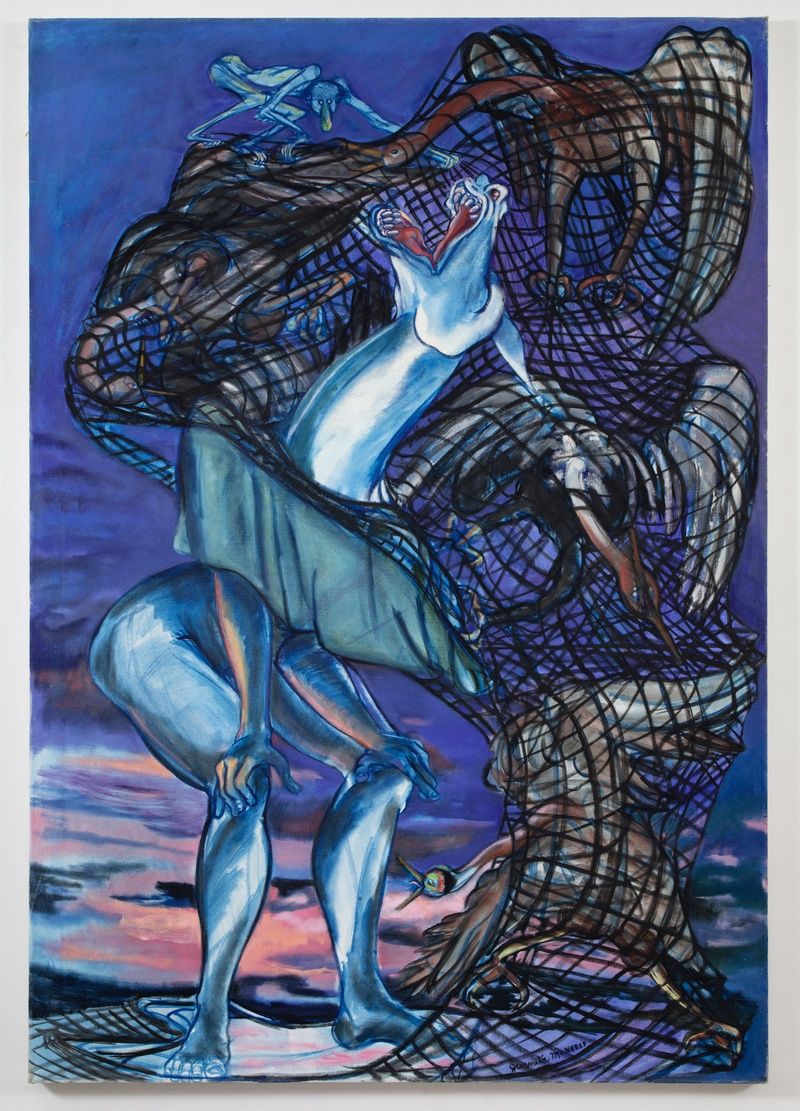
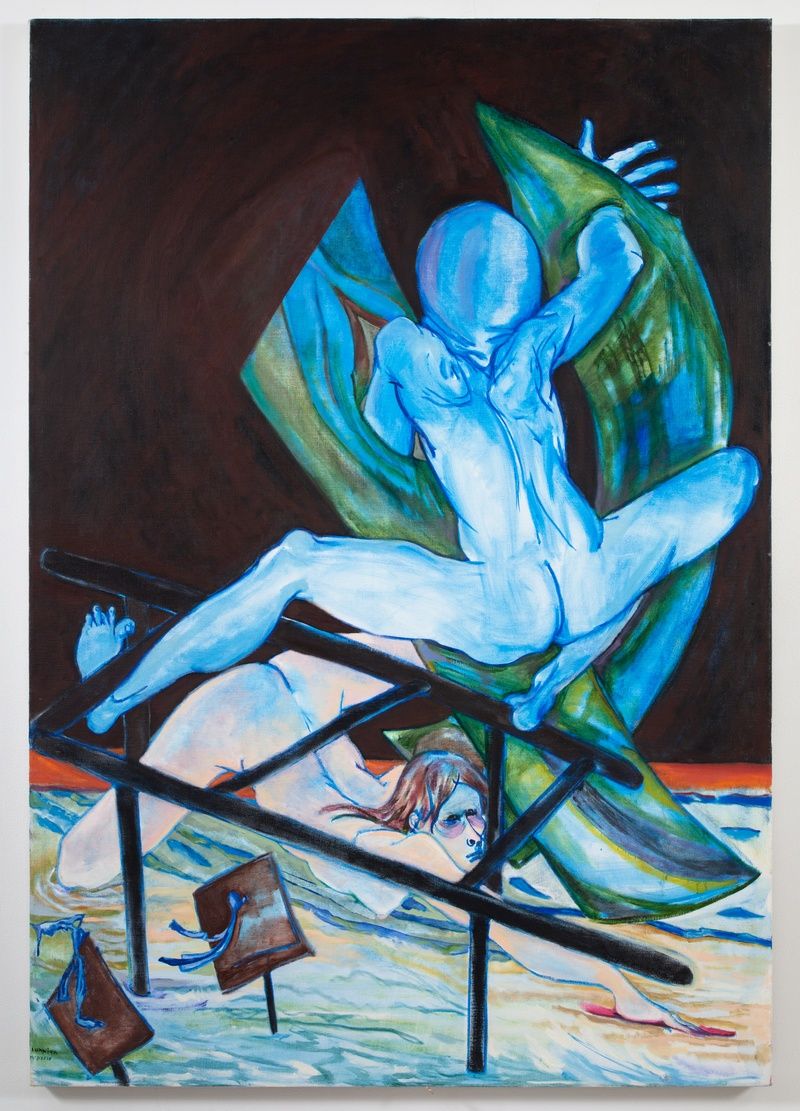
Across these works, McNeely stages profound formal experiments in composition and framing using tilted black ladders, windowpanes, netting, mirrors, and shadows. Like the body she depicts, the pictorial space buckles and spins, often fracturing into several planes that multiply and collapse simultaneously. Blue appears as both choppy ocean and sky, and proliferates in windows, shadows, and outlines. In kaleidoscopic fashion, the paintings tend to deny a single point of view, situating both figure and viewer within a destabilized perceptual field that continually reorients itself. In some, McNeely transmutes the linear motif into a single bloodied line, expressing not only the animalistic body but the canvas itself as flesh being sliced into. Across these registers, Kandinsky’s Blue Rider forms an evocative parallel, where blue and the creaturely figure operate together as charged emblems across the artists’ oeuvres.
James Fuentes is pleased to present Juanita McNeely: Holding Back in New York. Driven by the need to “make the ugly and the terrible beautiful for myself,” McNeely’s powerful visual vocabulary focuses on the human condition through radiant color ranges animated by light and shadow. Surrounding her highly recognizable figures—human and animal, often seemingly both at once—McNeely established a distinct set of visual devices that would crystallize her visceral imagery into deeply metaphysical confrontations with form. The exhibition spotlights a group of works begun in the 1980s and spanning her late career, steeped in vivid cobalt and deep ultramarine blues as an expressive and unifying force.
Across these works, McNeely stages profound formal experiments in composition and framing using tilted black ladders, windowpanes, netting, mirrors, and shadows. Like the body she depicts, the pictorial space buckles and spins, often fracturing into several planes that multiply and collapse simultaneously. Blue appears as both choppy ocean and sky, and proliferates in windows, shadows, and outlines. In kaleidoscopic fashion, the paintings tend to deny a single point of view, situating both figure and viewer within a destabilized perceptual field that continually reorients itself. In some, McNeely transmutes the linear motif into a single bloodied line, expressing not only the animalistic body but the canvas itself as flesh being sliced into. Across these registers, Kandinsky’s Blue Rider forms an evocative parallel, where blue and the creaturely figure operate together as charged emblems across the artists’ oeuvres.
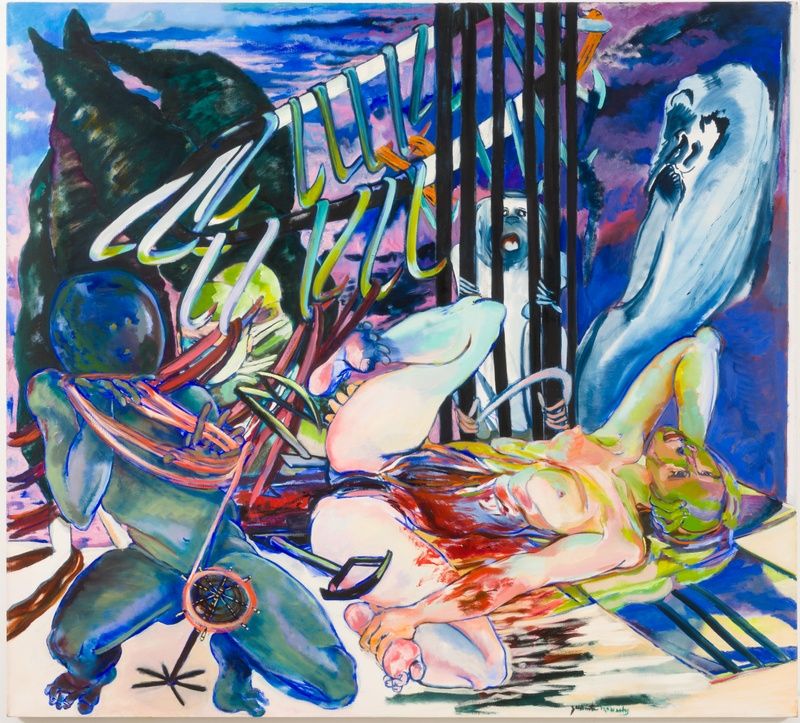
As McNeely builds an architecture of self-reflection within these canvases, she also evokes her own group of earlier multi-panel works in which the body is laid bare as both subject and site of revelation. The earliest on view, Pre-Abortion Law Remembrance (1985), echoes her pathbreaking nine-panel painting, Is It Real? Yes, It Is! (1969, collection of the Whitney Museum of American Art, New York), reckoning with the physical and psychic violence of her own near‑fatal fight for the life‑saving procedure. The latest and largest of her multi-panel paintings, the thirteen-part Triskaidekaptych (1986), directly heralds works in the exhibition such as Holding Back (2000), Balancing (2010), and Did You See? (2003). Across all, it is as if the multi-panel structure were reconstituted within one image that nevertheless remains split, layered, and internally plural. Brought together, this exhibition offers a direct view into the distinctive vernacular and energetic force that remain constant in McNeely’s legacy.
Juanita McNeely (1936-2023) was born in St. Louis, Missouri, and lived and worked in New York City. She received an MFA from Southern Illinois University, and a BFA from the St. Louis School of Fine Arts at Washington University. Arriving to New York in the later 1960s, McNeely was part of the Fight Censorship group founded in 1973 by Anita Steckel, alongside peers including Judith Bernstein, Louise Bourgeois, Martha Edelheit, Joan Semmel, Hannah Wilke, and Eunice Golden; as well as Women Artists in Revolution (W.A.R.), Redstockings, and other artist activist groups. A survey exhibition of her work, Indomitable Spirit, curated by Susan Metrican, was presented at Brandeis University’s Women’s Study Research Center in 2014. McNeely has been the subject of solo exhibitions at Levy Gorvy Dayan, London; James Fuentes, New York and Los Angeles: Mitchell Algus Gallery, New York; and Montclair State University, New Jersey, and has been featured in group exhibitions at the Whitney Museum of American Art, New York; Museum of Contemporary Art in San Diego; Rubell Museum, Miami and Washington DC; and Natalie Serrousi Gallery, Paris. Permanent collections include the Whitney Museum of American Art; Women's Studies Research Center at Brandeis University; the Minneapolis Institute of Art; the National Museum of History & Art in Taipei; the Oakleigh Collection at Skidmore College; Palacio de las Bellas Artes in Mexico City; the Rubell Collection; the Morris Library at Southern Illinois University; and the William and Uyendale Scott Memorial Women Artists Study Collection at Bryn Mawr College. Opening September 12, McNeely will be featured in the Counterpublic Triennial in the artist’s birthplace of St. Louis, MO.
Juanita McNeely Pre-Abortion Law Remembrance, 1985
Oil on linen
65 × 72 × 2 inches