James Fuentes Gallery
Jonathan Allmaier
Blackbird qua Blackbird
Opening reception: Friday, March 13 from 6–8 PM
Painting can only be developed along with the entirety of the world.
Both are created together (neither is created by me).
Opening reception: Friday, March 13 from 6–8 PM
Painting can only be developed along with the entirety of the world.
Both are created together (neither is created by me).
James Fuentes Gallery is pleased to present Jonathan Allmaier: Blackbird qua Blackbird in New York. The exhibition is anchored by two distinct but intertwined bodies of work completed over the last three years: large, chromatically dense abstractions and an intimate group of landscape paintings made from the artist’s studio window and in the Bronx Park. Together, the works engage contrasting formal strategies but share in the same set of questions: testing how a painting can think, direct, and even “make itself.” As Allmaier alternates between outward description and inward, tool‑driven abstraction, he tests how painting can construct the very looking that seems to precede it, allowing each canvas—regardless of scale or motif—to act as a material mind that develops alongside the world it helps bring into view.
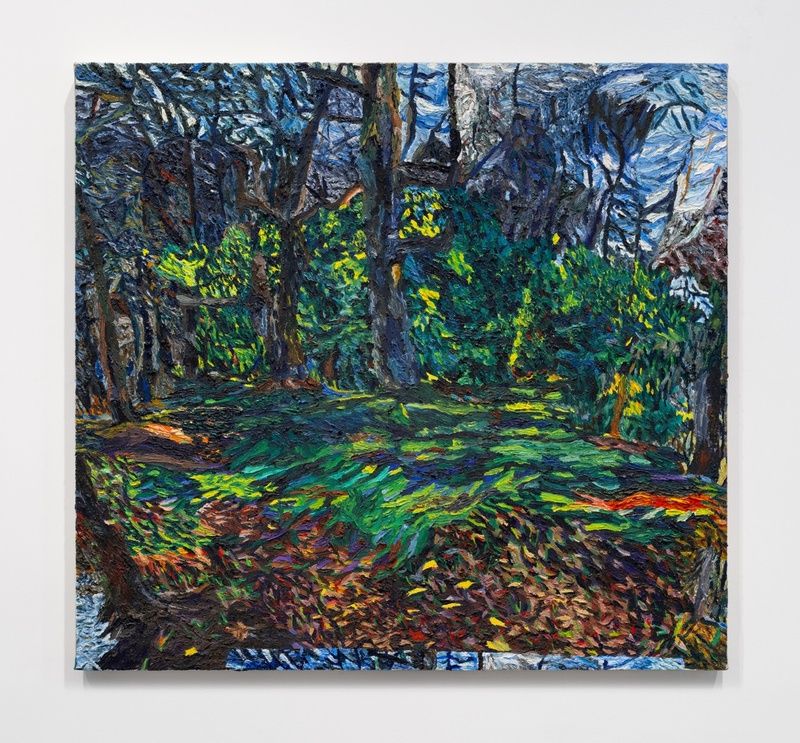
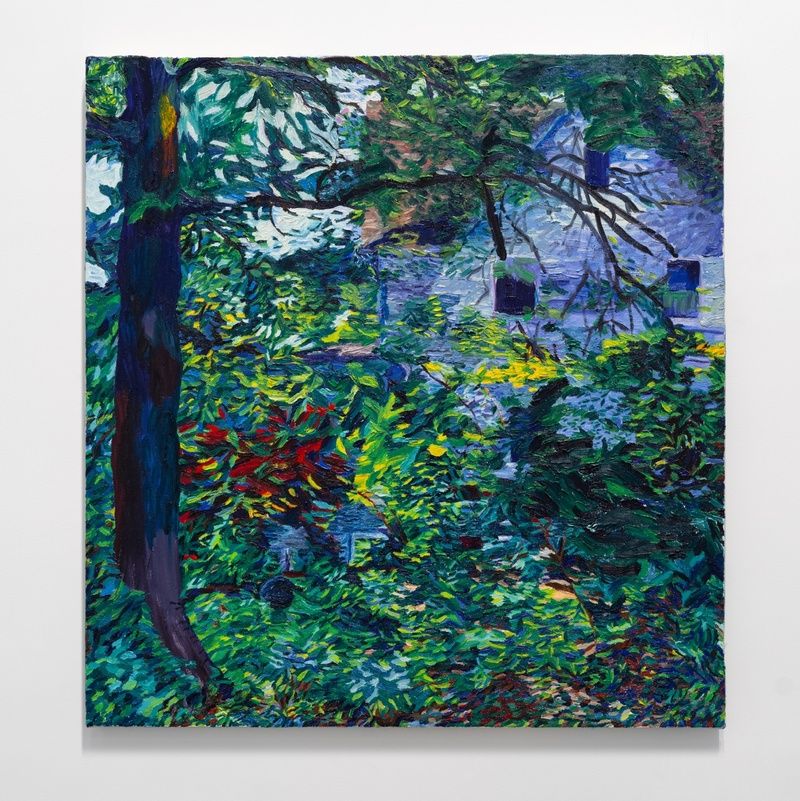
A striking departure from work he has previously exhibited, Allmaier’s landscape paintings were prompted by a psychological and physical pause in his studio practice. Confronted with storage impasses, he cut down the stretcher of an existing work into smaller supports. Working for six to nine months per canvas, Allmaier proceeded slowly from observation to paint the view outside his studio window, and later in the nearby Bronx Park. As with the larger non-representational paintings, this process was primarily motivated by color, tracking hard‑to‑parse shadows one day at a time. He started at each canvas’s center, and a subtle concentric effect takes place in each image as incremental seasonal shifts assemble outward like the rings of a tree.
For Allmaier, these are not simply representational scenes but manifestations of how painting constructs the very looking that seems to generate it: as he paints, the landscape he sees is literally reorganized by the process of painting it, so that world and work come into being together. As with the abstractions, every painting begins before paint is laid onto canvas. From scratch, Allmaier grinds and combines dry pigments with linseed oil and builds, stretches, and prepares his own canvases with rabbit‑skin glue and oil primer, so that every aspect of the painting—from color to support—is materially specific and self‑determined. By treating pigment, wood, and canvas as “already almost a painting,” Allmaier lets agency reside in the materials themselves, and positions himself as their “studio assistant.” His re-use of old stretchers follows this same path, “re‑drawing” a painting at the level of its structure, treating the stretcher as a foundational drawing and allowing earlier decisions, dimensions, and colors to act as active agents in the new work’s development.
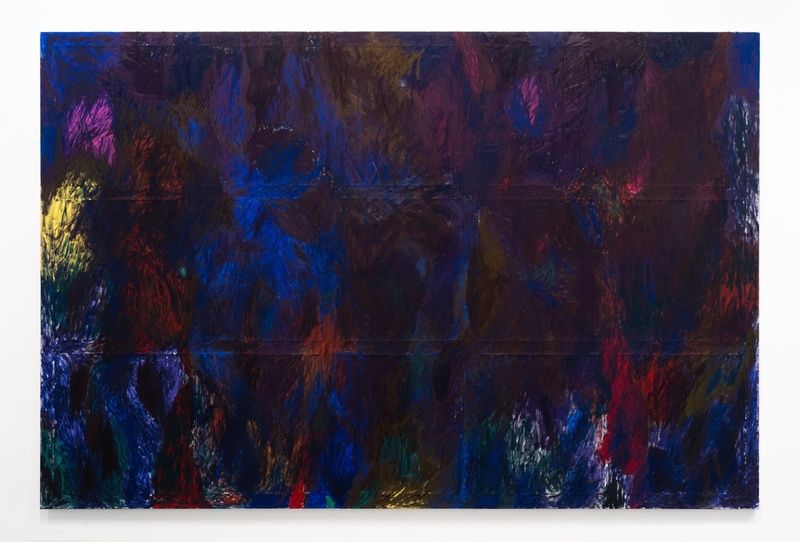
Central to the exhibition, large-scale abstractions such as Wretched Catullus and Three: (D), DS, UF, RP, E, MR, TD, A, B (both 2025) actualize this thinking at unexpected spatial and temporal scales. Each is built on stretchers scaled from canonical works by Milton Resnick and Clyfford Still, respectively, then worked on the floor with unconventional tools, including an old belt and a six-foot long pole with multiple tiny brushes attached (Three), and a Vibram five‑finger shoe, also attached, as well as simply the pole itself (Wretched Catullus). In other works, Allmaier has used a hairbrush, hair-dying brushes, an electric toothbrush, bedsheets, an old wallet, a cardboard tube, shoes, and his hands or fingers to apply paint. In these ways, Allmaier scrambles his learned hand-eye routines and allows the physical and mental properties of rubber, leather, bristles, and distance to determine the kinds of marks that can occur. Color and touch accumulate over long durations into dense, self‑generating surfaces.
Together, these groups of work advance Allmaier’s animist account of painting as literally a person in the world; at once a body and a mind. Through distinct approaches, including the two found in this exhibition, he understands painting as a way of embodied thinking rather than a vehicle for illustrating ideas, letting distinctions between concept and object undermine and even efface each other. Allmaier describes his cycling among different approaches to painting as a means of “changing myself”—an imperative driven by a radical commitment to the personhood of painting, rather than by aesthetic or stylistic concerns. Just as he cannot literally look out a window and paint at the same instant, yet each act constantly reshapes the other, this back-and-forth movement lets each mode develop and expand the other, allowing the next painting—whatever its format—to truly co‑develop from the material alongside the reality it inhabits.
Jonathan Allmaier (b. 1979, Catlin, New York) received his MFA in Painting from Tyler School of Art, Temple University (2007), and his BA in Visual Arts majoring in Philosophy from Brown University (2003). Blackbird qua Blackbird is the artist’s fourth solo exhibition with the gallery. Group exhibition venues include James Fuentes Gallery, A.D. Gallery, Peninsula Art Space, Deanna Evans Projects, and Curator Gallery in New York; Galerie Bernard Ceysson, Luxembourg; and the University of Hawai‘i at Mānoa. His work is held in the permanent collections of the Rubell Family Collection, Miami and Brown University, Providence. Allmaier lives and works in New York City.
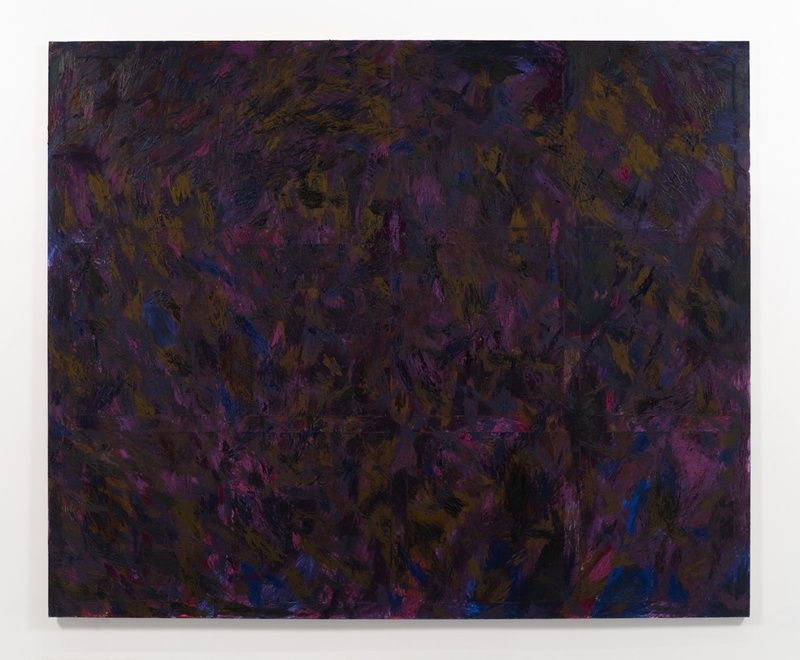
Wretched Catullus, 2025
Oil on canvas
89 × 108 ½ inches