James Fuentes is pleased to present Teruko Yokoi, A Pacific Line in Los Angeles. Born in Tsushima, Japan in 1924, Yokoi’s eight-decade career is defined by a profound artistic independence. Shaped by extensive travel and successive relocations, her work brought Japanese tradition into dialogue with postwar Western modernism, resisting any neat opposition of abstraction and image. Although recognized through major retrospectives and exhibited extensively across Europe, Japan, and the United States, A Pacific Line is the first solo exhibition of Yokoi’s work in Los Angeles in more than four decades.
The West Coast holds an important place in the Japanese-Swiss painter’s legacy. As the place of her arrival in the US by ship in 1954, it marks the starting point of her career as an artist outside of Japan. Only a year after the US occupation of Japan ended, hers was an unusually self-directed move—particularly uncommon for a woman artist—as she sought to expand her artistic language in direct contact with modern and contemporary art. Presenting works from 1954 through to 2005, the exhibition spans three continents and reflects Yokoi’s mastery of both paper and canvas mediums—including her transitional period exploring oils on paper, which bridged her earlier oil-on-canvas abstractions and her later egg tempera practice, characterized by large-format works and hand-mixed pigments containing pearlescent minerals and metallics.
Calling her paintings “poems written in colors,” Yokoi’s innate sensitivity to color, form, and light was rooted in the visual and poetic world of her upbringing. The dramatic landscape of the Kiso River region was the setting for Yokoi’s childhood, and walks in nature with her father cultivated her attentiveness to its changing conditions. A calligrapher and poet, he taught Yokoi both art forms, introducing her to the expressive economy of calligraphy and haiku. Following early lessons in traditional Japanese art, she moved to Tokyo in her twenties to study Impressionist painting under Takanori Kinoshita. While Yokoi’s earliest works were impressionist-inflected landscapes and portraits, she would soon explore beyond figuration, treating her subjects instead as sources of rhythm, light, and emotional structure. Her years in the US marked this crucial transition.
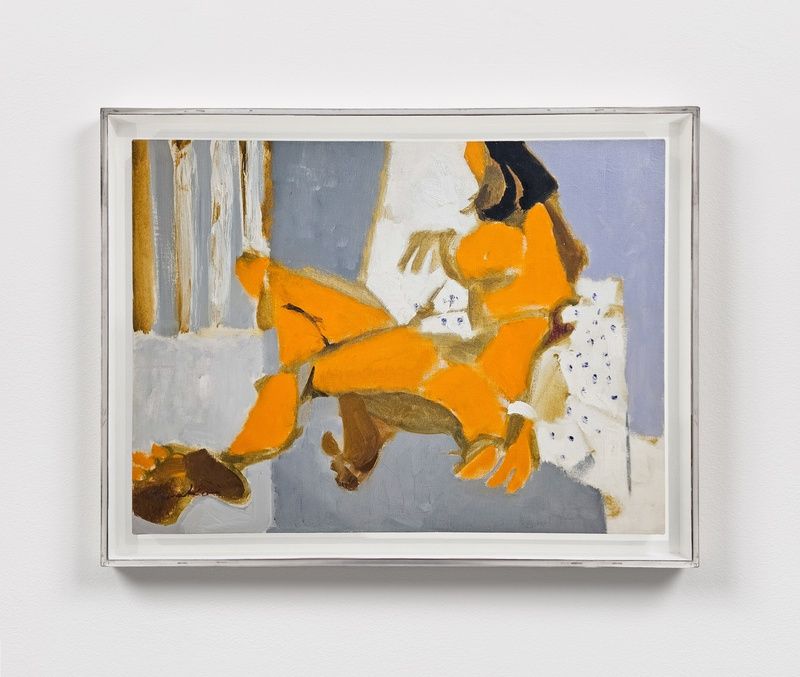
Made shortly after her arrival in San Francisco to study at the California School of Fine Arts (now the San Francisco Art Institute), Pose (1954) shows a discernible human figure whose contours shift into a field of loosely structured marks. At this early juncture, Yokoi was already honing the dynamic balance of the rhythmic brushwork and color-driven organization that would come to characterize her mature abstractions. She quickly gained recognition during this time, presenting solo exhibitions at the California Palace of the Legion of Honor and receiving a study grant that enabled her move to New York in 1955. There, she entered Hans Hofmann’s classes and attended the Art Students League. Over the remainder of the decade, Yokoi developed friendships within the orbits of gallerists Martha Jackson and Betty Parsons, including with Joan Mitchell, Kenzo Okada, and Mark Rothko, while living with partner Sam Francis at the Chelsea Hotel. Yet her time in the US would not prove long enough to see her work fully defined within any single movement. Amid the intensity of Abstract Expressionism, she continued to develop a visual language distinctly her own.
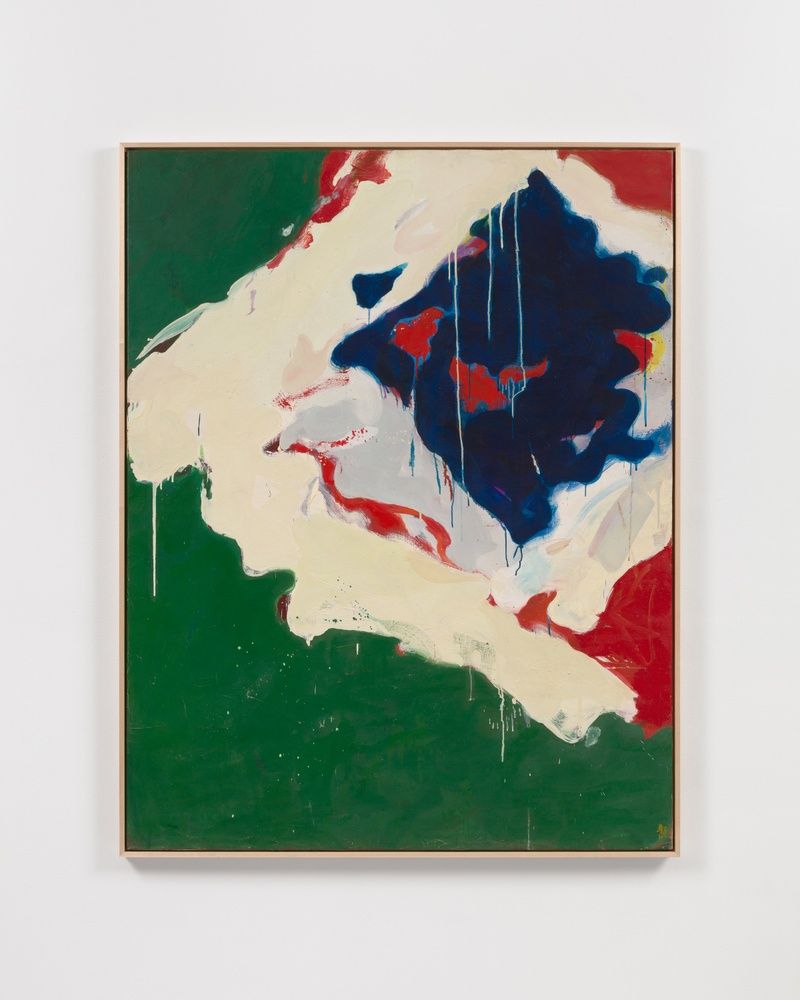
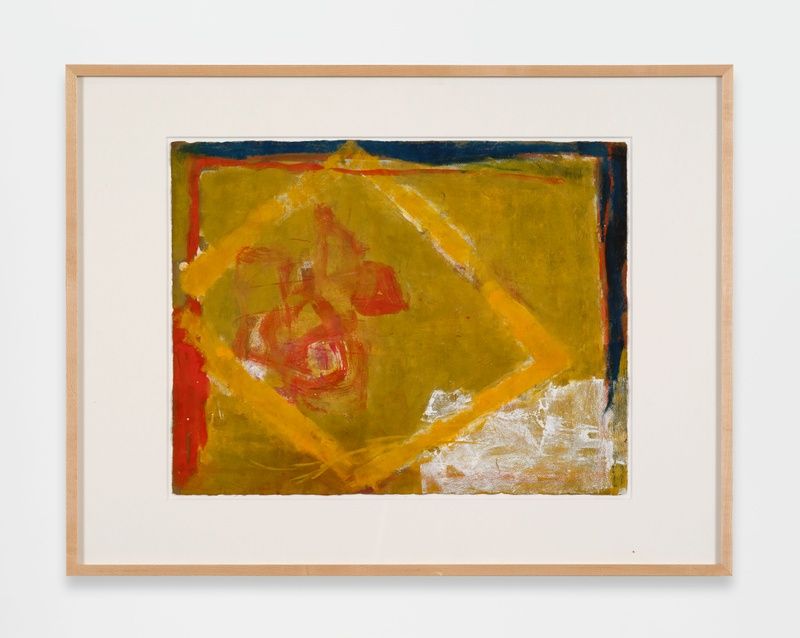
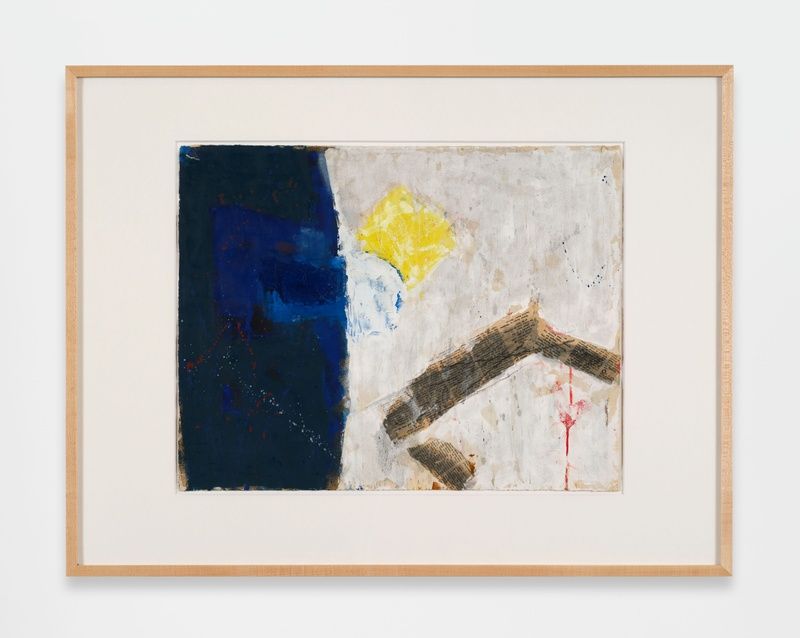
Unexpectedly denied US residency in late 1959, Yokoi relocated once again to Paris, where she expanded her larger-scale abstractions and entered the city’s international avant-garde. Painted during this transitional period, Shizen–Natur (1960) reflects the heightened attention to color, surface, and gestural structure that she developed amid postwar abstraction, while retaining the suggestive, nature-oriented sensibility central to her work. As well, Shizen–Natur declares Yokoi’s signature tilted diamond form as its central icon—its soft-edged presence first glimpsed in Pose‘s fragmented limbs six years earlier. Bookending the achievements of her early career, the work appeared in her 1961 solo exhibition at Tokyo’s legendary Minami Gallery. In addition, Yokoi’s smaller-scale works on paper from this time register the persistence of her practice throughout itinerant periods, adapting to changing material circumstances without compromising the rigors of her painting.
Bern, Switzerland would become her permanent home, from which she maintained a remarkably continuous practice for nearly six decades from 1962 until her passing in 2020. Early relationships with institutional patrons in Japan and gallerists in New York sustained her presence along broader postwar networks, even as her primary exhibition base shifted to Switzerland. Throughout, Yokoi’s works on both canvas and paper retain equal importance and, at large and small scales, represent the breadth of her artistic achievement. Neither support nor size determines their intensity, which instead distills through her exceptional command of calligraphic line, chromatic relation, and compositional balance. Layers of opaque paint and translucent passages reflect her fluency in color that appears to shift from within, achieving an outsized density and vibrancy.
Favoring oils, gouache, watercolor, and ink in her first paintings on paper, by the mid-1970s she shifted to working intently with egg tempera—a technically demanding medium requiring particular control and patience while posing new formal challenges. In works such as Meditation (1976), metallic zones activate the optical field through shifts of light and viewing position; by Ohne Titel (1993), a larger diptych, these investigations expand in scale while gaining material precision. The vertical structure of Ohne Titel echoes the emphatically upright proportions of earlier single-panel canvases such as Herbstwald (1965) and Lauschen II (Nocturne) (1969) as well as the later tempera series, Baume (2005). Though distinct, each expands Yokoi’s interest in compositional space not only through her wet media but via the physical proportions of the work itself. “Space is not just something you fill,” she explained. “The vertical space is like nature itself—stretching from the earth up to the sky.”
The profound singularity of Yokoi’s work is inseparable from her unique path through international postwar abstraction, forged across Japan, the United States, France, and Switzerland. Her career would span more than ninety solo exhibitions, including a major retrospective at Kunstmuseum Bern in 2020, and a 70-year survey at Koumi-machi Kougen Museum of Art, Nagano in 2015. Today, her works reside in the collections of The Museum of Modern Art, Cincinnati Art Museum, Yale University Art Gallery, California Palace of the Legion of Honor, Nara Prefectural Museum of Art, and Kunstmuseum Bern, among others. In Japan, two institutions devoted to Yokoi’s legacy were established during her lifetime by lifelong supporters, both mounting recurring exhibitions devoted to different aspects of her practice represented in their permanent collections. In 2004, the Teruko Yokoi Hinageshi Art Museum opened in Ena, Gifu Prefecture; in 2008, the Yokoi Teruko Fuji Museum of Art opened in Fuji, Shizuoka Prefecture. Yokoi’s ashes were interred at the Hinageshi Museum in 2023, in accordance with her wishes. Honoring her presence in New York, in 2025 the Chelsea Hotel opened Teruko, a Japanese restaurant and cocktail bar where a selection of Yokoi’s works, acquired by the hotel, remains permanently on view.
Teruko Yokoi, A Pacific Line is organized in collaboration with Emerald Room | Emerald Editions and Kent Fine Art.